Thứ Ba, 19 tháng 8, 2014

This week in 1971: Dr.Who


Yes, 'Dr.Who', not 'Doctor Who'. That was often how licensed BBC merchandise and comics had it back then. Even the Doctor Who TV series itself listed the character as 'Dr.Who' in the end credits for a while in the early days. And no one cared. 

Here's the Dr.Who strip that appeared on the covers of Countdown comic this week in 1971. Part of The Celluloid Midas serial illustrated by Harry Lindfield. Very nice artwork by one of the top comic artists of the day.

This of course was back in the days when The Doctor was a tall middle-aged grey-haired chap dressed in black with a red lining to the outfit. Wouldn't it be great to have a Doctor looking like that now? Oh, hang on...

Doctor Who returns to our TV screens on Saturday August 23rd! Don't miss it! 

Chủ Nhật, 17 tháng 8, 2014

This week in 1962: GIRLS' CRYSTAL

I've rarely featured girls' comics on this blog, mainly because I naturally didn't read them as a boy so I knew very little about them. However, over the years I've learnt that most of them did contain some great artwork and they're certainly on a par with any boys' comic. Different in story tone, with an emphasis more on character and emotional tension rather than action and violence, but equally as entertaining for their intended audience. 

Let's start rectifying things a bit with a look at an issue of Girls' Crystal that was published 52 years ago this week. Running for ten years from 1953 to 1963, Girls' Crystal was published by The Amalgamated Press, which by this time had become Fleetway Publications.

Comic historian Steve Holland tells me that the cover strip of this issue Tessa - She's a Tomboy, was drawn by Cecil Orr. A very nice lighthearted style, ideal for it. Incidentally, pogo-sticks and hula-hoops were indeed very popular in the early sixties. I remember the older local kids playing with them in the street. 

The 20 page comic carried a mixture of comic strips and prose stories, plus a page spotlighting the latest schoolgirl crush (in this case, Troy Donahue). This issue also carried an ad for the latest Princess pocket libraries...

Inevitably, there was a strip about nursing, a noble profession for anyone but very much encouraged for girls at the time. I Want to be a Nurse has some good line work but I'm not sure who illustrated it. (Update thanks to David Roach: The art was by someone named Ann Simmons or G. Simmons.)


Cherry and the Children was illustrated by John Armstrong, years before he drew the popular Bella strip in Tammy of course.


Only one humour strip in the comic; Little Angel. Again, I don't know who the artist was but it's a good, crisp style.

Ghost Village has a great spooky and atmospheric feel to it. Illustrated by Tom Kerr who, as most of you will know, drew many strips for various Fleetway boys' comics.


As with boys' British comics of the time, girls' titles of 50 years ago were aimed at a slightly older reader than they are today. Tastes and society have changed and it's unlikely girls of 8 to 13 years old would be interested in anything like Girls' Crystal now. Having said that, Manga was very popular with that age group a few years ago so there's always hope. Perhaps a modern version might work, but the expense of launching such a new title is a risk that most publishers would not dare venture into. It seems it's far safer now to launch a comic on the back of a brand (such as the new Lego Friends girls' comic) and aim it at the very young. 

Thứ Bảy, 16 tháng 8, 2014

Countdown to TV Action: review

I've been a sucker for books on the history of comics ever since I had The Penguin Book of Comics for Christmas 1971. Any book that provides more insight into the background of comics is usually an essential purchase for me, and Countdown to TV Action by Steve Holland definitely delivers the goods.

As most of you will know, Countdown was a weekly comic published by Polystyle in 1971 which featured licensed TV strips such as Doctor Who and various Gerry Anderson strips, along with features on science, space exploration, and Unidentified Flying Objects. A year after its launch it metamorphosed into TV Action, continuing the numbering and broadening its remit to incorporate strips based on other TV adventure shows of the time. (Here's a blog post I wrote several years ago about Countdown No.1:
http://comiconline24h.blogspot.co.uk/2011/02/40-year-flashback-countdown-no1.html)

It took quite a while for Steve Holland to compile this book because he always diligently researches his projects. At times you may feel there's a bit too much background career information on the staff of the comics Steve writes about, but it's actually good to have such thoroughly researched information. After all, why not give the staff and creators their due, when they've often worked in relative obscurity for years? 

The 202 page book not only covers the history of Countdown / TV Action but also puts it into context by giving us the brief history of the comics that preceded it (such as TV Century 21 and TV Comic) and the background to the publishers. Steve has unearthed many interesting facts about the behind-the-scenes story of the comic, and that, plus brief story synopsis', information on creators, and a substantial strip index at the back makes this book the definitive history of the title. 

That index takes up over 50 pages in itself, providing every story title and the issues they ran in, creator credits, feature titles, etc. Even information on the Holiday Specials and Annuals are included, and related titles such as the Doctor Who Holiday Special of 1973. 

The book is extremely well illustrated too, with many crisp clear reproductions of covers, artwork, and features. Some strips are even reprinted full size, taking up the whole page. I'm sure some would prefer it if they'd been shown in full colour, but this is a self-published venture with a smallish print run so the costs of colour would be prohibitive. The absence of colour is irrelevant anyway, as the focus of this book is on the history of the comic, and it certainly does its job.

Countdown to TV Action is a fine publication, carefully researched and handsomely presented in a very informative and enjoyable volume. If you read the comics as a kid you'll love it. If it's new to you, you'll discover the story behind one of the best British comics of the 1970s and marvel at the quality of its artwork. 

You can buy a copy directly from the publisher at Bear Alley Books by following this link:
http://bearalleybooks.blogspot.co.uk/2014/06/countdown-to-tv-action.html

Thứ Năm, 14 tháng 8, 2014

The first TOXIC Annual!


Although Egmont have been publishing Toxic magazine since 2002 the popular title has never had an annual devoted to it... until now. Toxic Annual 2015 has just been released so here's a brief preview of the contents.

I've been writing the Team Toxic strip since issue No.1 of Toxic, and drawing it since issue 14 or 15 so I was pleased to be asked to contribute a double length TT story for the annual. Double Trouble sees the return of one of the Team's long established bad guys, Techno Troll, who creates a Bogeyman out of discarded bogies. Can Team Toxic stop it from destroying the city? Probably, but then another enemy turns up!
There's also a double helping of Captain Gross strips by Russ Carvell, featuring the stinkiest superhero this side of Red Sonja...
Towards the back of the book there's a reprint of a Team Toxic strip I did a few years ago, - Stinky End! The Team have retired to a village of piped blazers and straw boaters... or have they? Fans of The Prisoner classic TV series might like a few of the touches in this. 
The majority of the annual is comprised of short snappy features and puzzles, mostly related to popular brands for children such as Skylanders, Pokémon, Lego, Super Mario and suchlike. The brief editorial at the front of the book tells us they've "gathered the best moments" from the magazine so I think most of the features are reprints. 
The book is very slim at 72 pages including covers, but 10 of those pages are comic strips so hopefully it'll appeal to some readers of this blog. The target age group for the annual is 5 plus, and I think it'd certainly be a very entertaining book for children of all ages. 

Toxic Annual 2015. Hardback, 72 pages. RRP £7.99. Published by Egmont. Available from booksellers and online. 
ISBN 978-1-4052-7211-7

Latest Commando comics


My thanks to the Commando editors for supplying me with the following info....
Commando Issues 4731-4734 – On sale 14th August 2014

Commando No 4731 – The Miners Of Messines

On the morning of the 28 June 1914 two pistol shots fired in a Sarajevo street had plunged the world into war and pitched men of all nations against one another. By 1917, men faced one another over a narrow strip of No-Man's-Land, unable to advance without incurring massive casualties.
   One group, though, could move across that gulf much more easily, for they were tunnellers who operated deep in the earth. Yet even they were far from safe. This is the story of...
The Miners Of Messines

Introduction

As a tribute to those who served during the years 1914-1918 — on the Home Front or at Front Line — Commando has produced a series of stories of characters caught up in the tumult of the First World War. None of them are real people but we’d like to think that the experiences they have will not be a million miles from what actually happened to so many.
   Last month, our story took our heroes into the battle for Vimy Ridge and this time it’s another ridge which dominates proceedings. However this one’s at Messines but the lads at the core of this tale aren’t fighting up its slopes, they’re burrowing underneath. Not a yarn for the claustrophobic.
   I hope you enjoy this and the other stories in the series as much as we have.

Calum Laird, Commando Editor

Story: George Low
Art: Keith Page
Cover: Ian Kennedy


Commando No 4732 – Jungle Ace

He flew alone, and he piloted a plane the like of which the RAF had never seen —a jet-black Mosquito.
   The only thing in all Burma feared by the all-conquering Japanese, the Mosquito came upon them like a screaming black shadow and as mysteriously disappeared, leaving utter destruction in its wake.
   Meet the pilot, the man who built this terror plane, the one they called “Lone” Wolfe.

Introduction

First of all, a warning — this story does not paint the Japanese in a very good light. Actually that’s a bit of an understatement. So if you’re easily offended, steer clear. That said, it doesn’t paint the “hero” in a particularly good light either. He’s obnoxious, cordially disliked and a man obsessed with war and killing.
   The foregoing doesn’t sound like a ringing endorsement, but in actuality the Fitzsimons narrative works well, pulling you along at a pace that lets you ignore other considerations. Helping out considerably is Medrano’s very precise black-and-white art. As pin-sharp and well-proportioned as any, it puts him right up there with the best comic aviation artists.
   Chaco’s cover is a lovely piece, but don’t be misled. This is an air story.

Calum Laird, Commando Editor

Jungle Ace, originally Commando No 115 (May 1964), re-issued as No 635 (April 1972)

Story: Fitzsimons
Art: Medrano
Cover: Chaco


Commando No 4733 – Danger On Board

 HMS Apollo was one of many Royal Navy destroyers which escorted vulnerable merchantmen as they steamed beyond the North Sea and across the dangerous waters off Northern Russia. Doubly dangerous, for the Germans seemed to know their every move, with an alarming number of ships being sunk by Kriegsmarine U-boats and destroyers.
   Midshipman Johnny Clark began to wonder if the enemy had some kind of help in obtaining their information. Surely none of the Apollo’s men could be a traitor…could they?

Story: David Turner
Art: Rezzonico
Cover: Janek Matysiak


Commando No 4734 – The Hunt Begins…

The valley entrance was dominated by the rock carving of a huge tiger, poised as if guarding the pass.
   To the Japanese soldiers it was a chilling reminder of the talk of the natives…that a giant man-eating tiger stalked these parts. But to their ruthless officer this was nonsense. He was enjoying his favourite sport of hunting down escaping POWs, and he wasn’t going to let any superstitious rubbish get in his way!

Introduction
For me, Commando’s toughest tales have always been set in the unforgiving jungles of the Far East. This really hit home when the Gold Collection started to re-visit the earliest jungle stories originally published from 1961 onwards. Having been too young to read them first time round, I was genuinely surprised by just how hard-hitting and gritty they were.
   Although The Hunt Begins… is from 1989, it certainly evokes those edgy 1960s classics, with some unrelenting action and a monstrous villain at its core.

Scott Montgomery, Deputy Editor 

The Hunt Begins…, originally Commando No 2295 (July 1989), re-issued as No 3859 (November 2005)

Story: Cyril Walker
Art: Ibanez
Cover: Ian Kennedy


Thứ Ba, 12 tháng 8, 2014

TV TORNADO (1967)

As with Solo (covered in the previous blog post) TV Tornado was a comic launched by City Magazines after the successes they'd had with TV Century 21 and Lady Penelope weeklies. Unfortunately it never reached the heights of popularity of those two comics, although it did manage to run for 88 weeks.

TV Tornado was a bit... odd. Take a look at the cover to issue 1 above for example. Various redrawn images of popular characters but the composition is quite bizarre, with Tarzan apparently threatening Batman and Robin much to the amusement of Hoss from Bonanza and the nonchalance of Superman. Even as a 7 year old I thought this was a strange cover, and I'm sure most readers would have preferred a more heroic illustration of Batman rather than the peculiarly cowering one that was used. 


Inside, the editorial by 'Ed Storm' tells us that TV Tornado is a "bumper bundle of thrills" featuring comic strips and text stories. It neglects to mention that The Phantom isn't actually a TV show, but perhaps he came as part of the King Features deal to use Flash Gordon. (Flash wasn't a TV series either at that stage but kids were familiar with him due to the 1930s chapter serials still being screened at Saturday morning matinees at ABC cinemas.) 


Everything about TV Tornado screamed low budget, from its one colour page (the front cover) to its use of prose stories and U.S. newspaper strips. It does have some interest for collectors though. Here's a three page Batman text story from issue 1...


There were also text stories for The Man from UNCLE and Superman...


Curiously, Batman and Superman were only in the first few issues. The next issue I have is issue 10, by which time they'd been replaced by The Green Hornet and Magnus, Robot Fighter. The latter was a popular American comic published by Gold Key but the strip in TV Tornado appears to be new.

TV Tornado also carried a new humour strip, - Dan Dan the TV Man by Denis Gifford...

With issue 37, the comic became TV Tornado and Solo, absorbing its ill-fated companion comic.

By this time, The Saint was starring in the comic, based on the hugely popular Roger Moore TV show.


A new addition to the merged title was The Mysterons, in order to cash in on the Captain Scarlet and The Mysterons TV series which debuted on ITV that week. The first episode of this strip had appeared in the final issue of Solo the week before (see my previous post). Despite being drawn by Don Harley, one of the top artists of the day, The Mysterons was a strange concept for a strip. In the TV series, we only see the Mysterons as copies of the humans or vehicles they've destroyed, created by twin circular beams of light. The comic strip took the imagery literally, initially showing the Mysterons as beings of hooped light, then changing them into physical hexagonal beings! The idea behind the stories seems to be to emulate the style of The Daleks strip from TV21, but it really struggles to work and I can't imagine many readers really connecting with it. 


The editor of TV Tornado was someone who'll be very familiar to many; Mick Anglo, creator of Marvelman. He also illustrated some of the material for TV Tornado, including the Voyage to the Bottom of the Sea strip and some covers I believe. 

TV Tornado lasted for 88 issues, and merged into TV21 in September 1968.  

Thứ Bảy, 9 tháng 8, 2014

SOLO (1967)


The 1960s were a prolific time for comics and many were selling in tremendous numbers. Some however didn't fare so well. One of those was Solo, published by City Magazines and Century 21 Publishing, which lasted just 31 weeks.

With the successes of TV Century 21 and Lady Penelope, City/Century 21 clearly felt confident enough to expand their line. They launched TV Tornado and the bizarrely unsettling nursery comic Candy in January 1967, swiftly followed by Solo a month later.

Solo was a bit of an odd mixture to begin with. Some of its contents were licensed Walt Disney strips, while the rest of the comic covered other TV programmes. This meant it contained things such as a strip adaptation of Disney's version of Mary Poppins...


...running alongside the adventures of The Man from UNCLE...


Two different target audiences in one comic. A recipe for disaster. 

The main focus on the early issues was the inclusion of The Scarecrow, based on the new Disney TV mini-series starring Patrick McGoohan (shown in the UK as the movie Dr.Syn alias The Scarecrow). The full colour centrespread of the comic featured the comic strip drawn by Dan Spiegle, although I understand this was edited together from the American comic published by Gold Key.

Solo also featured other reprints from American comics such as the Super Goof and Uncle Scrooge short stories. There were home-grown funnies too, with a Sgt.Bilko page drawn by Tom Kerr...

...an originated Batman spoof, Fatman and Sparrow, also by Tom Kerr...

...and a strip based on US comedy Run, Buddy, Run drawn initially by Reg Parlett!

The back page featured an advertising strip drawn specially for Solo, - Dinky Driver drawn by Jon Davis. (Rivaling TV21's Corgo Model Club News.) 

All in all, a strange mixture of stories with no one strip being a huge draw. (I remember giving up after issue 1, completely disinterested and put off by Mary Poppins which I considered too babyish by the time I was old enough for The Man from UNCLE and Sgt.Bilko.) It was inevitable the comic would have to change.

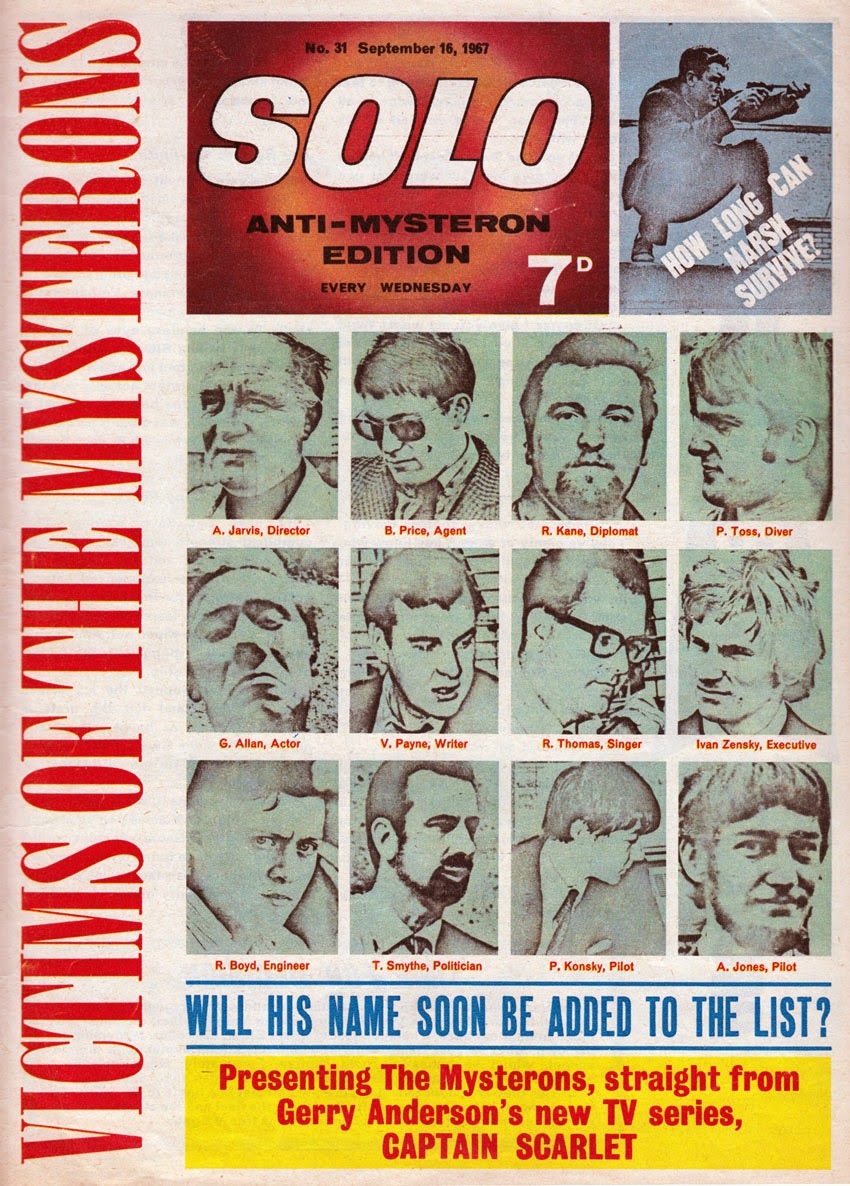
That change came quickly with issue 19, heralding a redesigned logo and more of an inclination towards its older age group. The masthead also now carried the words 'Anti-Mysteron Edition', and warnings about the Mysteron threat. As the Captain Scarlet TV series hadn't even begun yet, this may have led to a few confused readers. 

Unsurprisingly, the revamp didn't help sales and Solo published its last issue dated September 16th 1967, still a week or two before Captain Scarlet began on ITV. Its chilling cover headlining the 'Victims of the Mysterons', - presumably photos of staff members at City Magazines. 

Inside, Spectrum News tied in with the cover story, and was equally bleak, whipping up its young readers' paranoia against an imaginary menace.

Preparations were under way for Solo to merge into TV Tornado, although the announcement was fairly underwhelming...

That issue also carried the first episode of The Mysterons, - a three page strip telling the story from the point of view of Spectrum's antagonists! As in the TV series, it's Earth who inadvertently begin the war. Art by Don Harley.


A new non-licensed adventure strip had begun with the revamp, - Tomorrow West, about a time traveller stuck in the old West. 


Solo was a slick production; 24 glossy pages, excellent Photogravure reproduction, but I think its initial uncomfortable mix of stories and its later Mysteron-themed items (before the TV series had even aired) did it no favours.

You can read more about Solo and other Century 21 titles at the excellent Technodelic website: 
http://www.technodelic.pwp.blueyonder.co.uk/Upload02/MarkoftheMysterons.htm