Hiển thị các bài đăng có nhãn Eric Bradbury. Hiển thị tất cả bài đăng

Thứ Sáu, 19 tháng 6, 2015

The Valiant Book of Mystery and Magic 1976

The 1970s saw a rising interest in fiction dealing with horror and the occult. The Exorcist and The Omen in the cinema for example, The Pan Book of Horror being a popular series of paperbacks, and the relaxation of the Comics Code allowing vampires, werewolves and other horrors in American comics that were reaching more UK newsagents than ever before. Teens, adults, (and kids if they could access it) enjoyed nothing better than a good scary story. 

How could British comics join the fun? The Children and Young Persons (Harmful Publications) Act 1955 had forbidden the production of horror comics in the UK due to alleged effects on children, a kneejerk reaction to 1950s horror comic imports (see here). However, stories of the supernatural had continued to appear in British comics occasionally, although they tended to be very tame.

In 1975, IPC decided to publish a one-off hardback edition called The Valiant Book of Mystery and Magic. The closest thing they could get away with to a horror comic without being too graphic. Most of the stories featured The Spellbinder character; the old magician who had been the lead strip in Lion weekly. (By this time Lion had merged into Valiant.) However the book also contained several one-off mystery stories illustrated by IPC's top artists.

The book had 144 pages, mostly in black and white. The full colour lead strip, The Hand of Tuthoon, written by Frank Pepper and drawn by Fred Holmes, reintroduced readers to The Spellbinder, revealing how Tom Turville had awakened his ancestor Sylvester Turville from suspended animation.

The book also included one of the Spellbinder serials from Lion, edited into a 33 page adventure. The rest of the book featured all-new material. Perhaps the most intriguing strip was The Final Victim, an early collaboration between Pat Mills and Joe Colquhoun several years before they created Charley's War for Battle. In The Final Victim, Colquhoun drew himself as 'Albert Weems', a comic artist down on his luck. Presumably the comic's managing editor 'J.J. Legrun' was based on IPC's Jack LeGrand. Here's the whole story...


Joe Colquhoun also illustrated some other material in the book, including two text stories, The Red House and Nightmare and the short comic story The Man on the Road...


Other great talent in the book included Eric Bradbury...


...Fred Holmes...

...and of course Geoff Campion, the main Spellbinder artist who also contributed some art for text stories and the endpapers...


The Valiant Book of Mystery and Magic was a one-off, which suggests it either didn't sell very well or IPC decided to shy away from the subject. It's a fantastic book though, as you can see from the examples I've shown here. Well worth seeking out if you don't have a copy. 

There's one hugely important thing about it that you may have noticed; the stories all carry writer/artist credit boxes. Hats off to the editor for doing this as it was definitely not usual IPC policy at the time, and wouldn't be seen again until 2000AD started publishing credits a couple of years later. 

Thứ Ba, 19 tháng 5, 2015

SCORE 'n' ROAR No.1 (1970)

With their first new boys' adventure comic Scorcher having been established for several months, IPC launched another football weekly on Saturday 12th September 1970. Score 'n' Roar used the same gimmick that IPC's Whizzer and Chips had pioneered a year earlier; two 'rival' comics in one. 16 page Roar was inside 16 page Score and could be separated by opening up the staples.

Kicking off the new comic the first strip was Jack of United, superbly drawn by Barrie Mitchell. A fairly standard football strip about two rival brothers but the interesting thing was that the plot concerning Jack's brother Jimmy continued into his own strip, Jimmy of City, in Roar.

Unlike Scorcher's newsprint format, Score 'n' Roar had the benefit of expensive photogravure printing. This enabled an excellent reproduction of photographs and the comic took full advantage of this by including several feature pages. Score had its opinion page written by 'The Captain'. I'm presuming the chap in the photo may be the comic's editor Dave Hunt. Can anyone confirm or deny this?
Cannonball Craig was somewhat like Scorcher's Billy's Boots in that its star was a youngster who was useless at football until aided by artificial means. In Billy's case it was his magic boots, and in Craig's case it was... wait for it... nuclear irradiated bubble-and-squeak! The artwork on this first chapter is by Mike Western, but Mike White drew later episodes.

Here's how Roar was bound into the centre of Score...
Roar's first strip was the aforementioned Jimmy of City by Barrie Mitchell, continued from Jack of United in Score...
Roar had its own opinion page headed by 'The Inside Man'. I'm pretty sure that the photo is of Bob Paynter, group editor of IPC's humour comics. He was a bit greyer when I knew him but that was 14 years later. I doubt Bob actually wrote the column but comics often used photos of staff members in this way. 
The great Tom Kerr was on board, illustrating the two page Peter the Cat strip. The name was inspired by real-life goalkeeper Peter Bonetti who was nicknamed 'The Cat', but the strip is not about him. 
The centre pages featured Mark Your Man, an Agatha Christie style mystery involving a process of elimination of the suspects. Art on episode one by Geoff Campion, but John Catchpole drew later episodes...
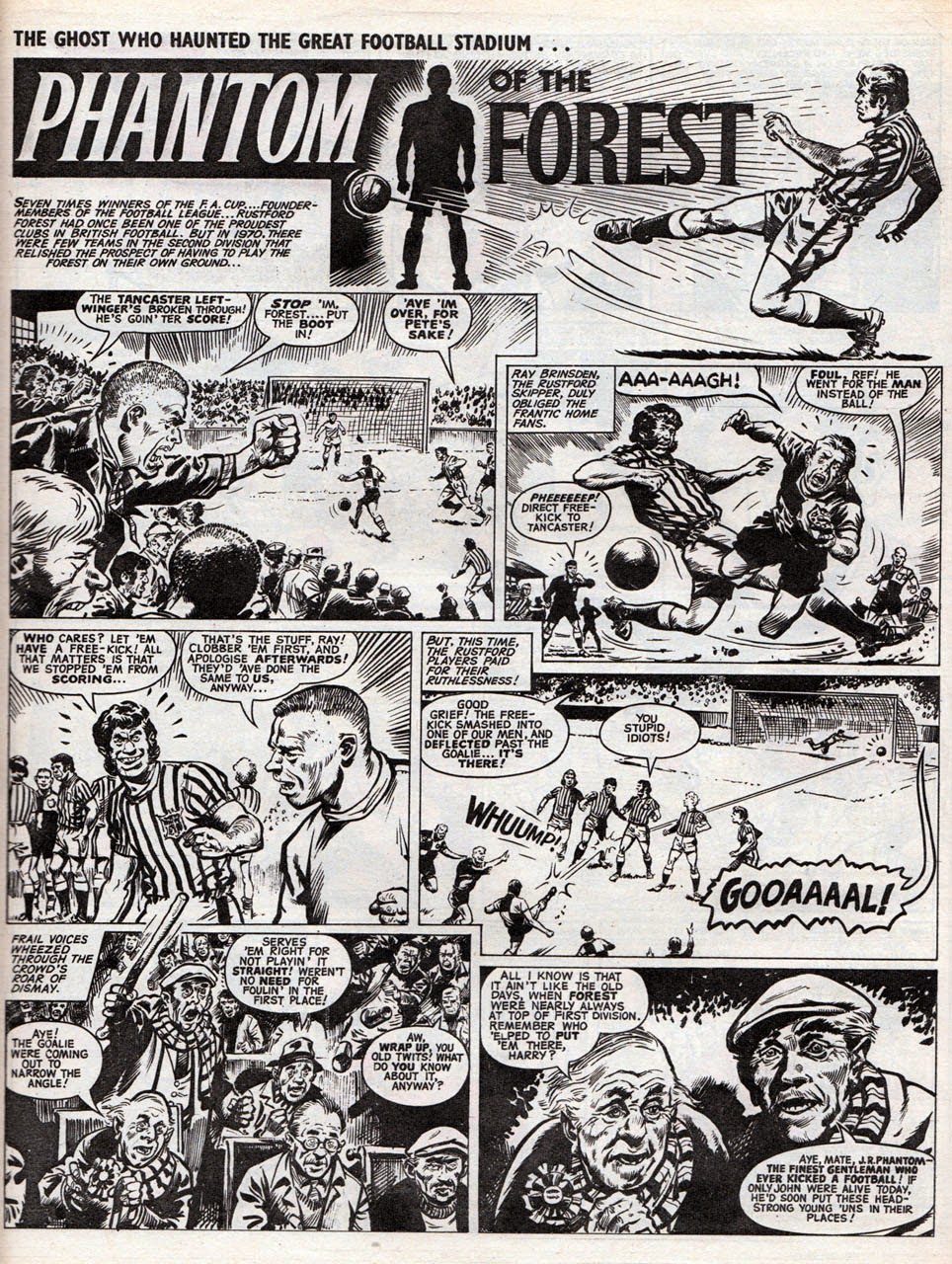
A supernatural three-pager next, with Phantom of the Forest about a ghost footballer. Art by Eric Bradbury, but Jesus Blasco drew later episodes. (I'm guessing that so many of the strips soon lost their original artists because the first episodes would have been produced many months earlier for the dummy issue and perhaps they couldn't fit the extra workload in regularly.)


The Mudlarks next, with art by Ted Kearon.
Back to the second half of Score for the next strip, and the one that was destined to become the most popular and enduring. Here's the very first episode of Nipper, illustrated by the Solano Lopez studio giving it a bleak, grimy look befitting the setting of the fictional industrial town it was set in. Nipper was actually written more like a story from a girls' comic, with an aspect of pathos and the underdog's struggle against his situation. He even had a cruel guardian. Clearly this touched a chord with readers and the strip survived for many years, transferring to Scorcher, and later Tiger, when the comics merged. I don't know who the writer was on these early Nipper strips but Nat Munger is a great name for a bad guy!  


After the grim despair of Nipper, the comic lightened things up for its last strip with Lord Rumsey's Rovers, a comedy drama drawn by Douglas Maxted (although another artist soon took over in subsequent weeks).
Overall, I felt that Score 'n' Roar was a better comic than Scorcher. Its stories seemed stronger and the better paper enabled good photo features. It soon added a humour strip, Trouble Shooter by Graham Allen, and you can see an example of that on a post I did seven years ago (click here). Sadly the comic didn't survive for long. Its paper quality declined and merged with itself in 1971, dropping the Roar part of the title, and then Score merged into Scorcher with the issue dated 3rd July 1971. 

Thứ Bảy, 11 tháng 4, 2015

Valiant and Smash! Summer Special 1971

Although not as slick or colourful as DC Thomson's Summer Specials, the rival products by IPC in the early 1970s were great value for money. Here's the evidence in the form of the Valiant and Smash! Summer Special published in 1971; 96 pages packed with strips old and new, with a striking cover by the great Mike Western. Let's look at a selection of pages...

Inside, there were extra-length stories of favourites from the weekly, such as a six page strip of His Sporting Lordship. Douglas Maxted was the artist on the weekly strip but specials often used replacement artists and in this case Jack Pamby turned in an excellent job... 

Similarly, on The Ghostly Guardian, regular artist Julio Schiaffino was replaced by Bill Lacey (father of humour artist Mike Lacey)...

One original artist who did draw the Summer Special version of his strip was Ken Reid, producing a nice two page Banger and Masher...


For budgetary reasons the IPC specials contained a lot of reprint, but readers didn't mind if we hadn't seen the stories before. A 1960s Karl the Viking serial from Lion was edited and recycled as a 16 page Erik the Viking epic. Artwork by Don Lawrence...

The specials also stretched out the budget by including features and prose stories. Here's the first page of a one-off story entitled The Radar Men, illustrated by Eric Bradbury...

A new Raven of the Wing six pager was included. I'm not sure of the specific artist but it looks like it may be by the Solano Lopez studio but possibly not by Lopez himself. (The kids in the bottom left hand corner don't look like his style.)

Only 8 of the 96 pages were in colour, two of which were given to The Swots and the Blots. Although the header (taken from the weekly) was by Leo Baxendale the strip itself in this instance was drawn by Les Barton...


The Special concluded with a nice lengthy 18 page Kelly's Eye strip by Solano Lopez. This was a revised reprint from a serial that had run in the weekly in 1964/65.

This edition and numerous other IPC specials provided hours of entertainment in the school holiday periods back then. Over the years the page count reduced from 96 to 80 then to 64... and even down to 48 in some cases, with the cover prices getting higher. That initial period of 96 page Specials certainly provided the best value for money. Happy times!

Thứ Ba, 31 tháng 3, 2015

Drac's back! Classic SCREAM! strips reprinted

Ireland based publisher Hibernia Comics have produced another winner in the form of an 86 page collection of a classic strip from Scream! weekly. The Dracula File contains the complete run of the fondly remembered story from the 1980s written by Gerry Finley Day and Simon Furman and illustrated by Eric Bradbury and Geoff Senior.

Scream! was a horror comic for boys published by IPC but sadly cut short after 15 issues by a strike. Even though it was only around for a fleeting time the comic has its fans who remember it well. The Dracula File, featuring Dracula in present day England, was one of the best strips in the comic, notably for the atmospheric artwork by the late great Eric Bradbury. Egmont now own the rights to the strip but have allowed Hibernia to publish the comic by special arrangement. 

The Dracula File collects all of the episodes plus material from the Scream Holiday Special and bonus features. It's available to buy now directly from the publisher. Check out their other books too. I highly recommend all of them:
http://www.comicsy.co.uk/hibernia