Hiển thị các bài đăng có nhãn Brian Lewis. Hiển thị tất cả bài đăng

Chủ Nhật, 5 tháng 4, 2015

The House of Hammer!

There aren't many comics I regret getting rid of during the times I've pared my collection down over the years but I do sometimes wish I'd held onto the full set of The House of Hammer that I'd bought on publication. 

For the benefit of those of you unfamiliar with this title it was a British rival to the imported American mags such as Creepy and Famous Monsters and, in many people's opinion, was actually better than those magazines. Published by Top Sellers and edited by Dez Skinn, The House of Hammer (or Halls of Horror as it was later retitled) featured comic strip adaptations of classic Hammer films illustrated by top UK artists such as Brian Lewis, John Bolton, and Paul Neary, alongside a bevy of movie articles and reviews by people such as John Brosnan, Tony Crawley and Denis Gifford.

I recently bought a 1978 edition of The House of Hammer No.14 direct from Dez. Let's have a quick look at the contents. 

The cover by Brian Lewis (above) was one of the most striking to grace the magazine. A wise choice by editor Dez because Raquel Welch was the first screen crush of many a young lad, myself included. Brian Lewis was an outstanding artist, able to turn his hand to both realistic paintings and cartoon humour work. (He drew many of the Charlie's Choice strips for Smash! in the sixties.) Sadly, Mr.Lewis passed away later that year, far too young at 49. 

As announced on the cover, the strip adaptation for this issue was One Million Years B.C., Hammer's daft but fun 1966 movie of dinosaurs living in the same era as cavepeople with perfect teeth. Writer Steve Moore provided the comic's script and John Bolton illustrated it.

They did a fine job too. This was a case of the comic strip adaptation being superior to the movie script. The film was without dialogue, apart from primeval grunts and snarls, so Steve Moore had a bit of a challenge to make the story interesting for print. A challenge he rose to admirably by creating a descriptive narrative for each panel. 

John Bolton also went above and beyond the call of duty to turn in some wonderfully detailed artwork. This was in the early days of John's career and the influence of Frank Frazetta's work was evident in several panels but Bolton's own illustrative skills definitely shone through. 

It can't have been that easy to adapt a 90 minute film into 15 pages but Moore and Bolton managed it and the strip runs at a good pace. It also managed to out-cheesecake the movie, which was no mean feat. As this was the 1970s, and comics were keen to be 'adult', a bit of nudity in the form of a 'nip-slip' was included, which certainly wasn't in the film. Quite daring for a British newsstand comic at the time.

The rest of the 52 page mag was taken up with various articles, reviews and suchlike on movie subjects as varied as George A. Romero talking about his new movie Martin, an interview with veteran actor John Carradine, and a look back at 'Lost World' movies of the past. 

For many of us back then, House of Hammer had the ideal mixture of comics and features all in one magazine. It was an excellent production by Dez Skinn and his team. Bear in mind that HoH was published before 2000AD and Warrior so it was quite groundbreaking (although Kevin O'Neill's Legend Horror Classics had beaten it to newsagents shelves by a year).

If you want to read more about the history and background of House of Hammer you can't do better than reading the words of the man himself Dez Skinn. Take a look at his fascinating website here:
http://dezskinn.com/warner-williams-2/   

Thứ Ba, 31 tháng 3, 2015

Comic oddities: ZERO-G

Back in 1989 to celebrate the 20th anniversary of the moon landing, Polystyle Publications gave us a comic themed around science fact and fiction. Its name was Zero-G

Of course Polystyle were famous for publishing TV Comic, Pippin and Countdown / TV Action but Zero-G may be new to you. It'd be understandable if you missed it as there was only this one issue published as a Holiday Special. After the summer of 1989 it vanished from the shelves as though it had never existed.

The contents of this 48 page special contained a mixture of factual articles on space exploration and a good selection of complete adventure strips. However, the strips were all reprints from the 1971 comic Countdown

Although most of Countdown's strips had been based on TV shows it also sometimes featured all-new complete sci-fi stories with no connection to any television series. It was these strips which were collected into the Zero-G Holiday Special. Great material too, with artwork by Brian Lewis and Martin Asbury. 

There was also a four page text story Dangerous Friend reprinted from the Countdown Annual 1972 that had been laid out differently. This Martin Asbury illustrated tale featured the cast of the Countdown ship, the originated strip from the comic of that name. 

Talking of layouts, the strip Murder on Ice bizarrely broke its continuity halfway through to feature a few joke cartoons, which seemed a bit foolish and unnecessary.

Was Zero-G intended to spin off into a regular comic? Possibly not, as there wouldn't be enough non-TV reprint left to fill the pages of an ongoing title, unless Polystyle would be willing to finance new material. That seemed unlikely, given that the Holiday Special was obviously done on a limited budget. Even the rocket icon on the cover had been lifted from the old Countdown logo. Times must have been hard not to afford a one inch drawing of a new rocket.  

So the Zero-G Holiday Special was a here today, gone tomorrow publication, passing like a comety candle in the wind burning up on re-entry lost in splashdown, add your own metaphorical analogy thing. Like Polystyle's parrot it had ceased to be. 

Chủ Nhật, 8 tháng 2, 2015

SMASH! The first 20 covers

When one thinks of the first series of Smash! comic (1966 to 1969) it may be the Batman strip of the covers that comes to mind. However, the comic's front page shifted and changed a bit before the Caped Crusader took up his position. Here's a look at all the issues leading up to that point. 

On February 2nd 1966 Smash! No.1 (above) debuted with a great Leo Baxendale cover promoting the free cardboard gun. The influence of Carl Giles was always evident in Baxendale's work of this period but Leo went in his own direction with it, enhancing his own style and bringing his creativity to every job. And it's incredibly funny too of course. 

Leo Baxendale was called upon to produce similarly manic covers to promote the free gifts in issues 2 and 3...

Issue 4 saw the arrival of The Man From B.U.N.G.L.E. (inspired by TV's Man From U.N.C.L.E.) and another cracking cover by Leo...
The cover to issue 5 was also by Leo Baxendale. Incidentally, the villainous 'Doctor Doom' was suddenly renamed 'Doctor Goole' in later issues to avoid confusion when Odhams started reprinting Marvel material. 
With issue 6, Ron Spencer became the new artist on The Man From B.U.N.G.L.E. doing a pretty good ghosting of Leo's style...
Issue 7, again by Ron Spencer. 
Issue 8, and a slight change, with B.U.N.G.L.E. as two panels this week. More great monsters drawn by Ron Spencer...
Uh-oh, here come the Chinese racial stereotypes on the cover of issue 9...
Issue 10, and an unusual Easter cover, again by Spencer...
Issue 11, again by Spencer...
Issue 12 saw a refreshing change with a split cover between The Man From B.U.N.G.L.E. (drawn by Ron Spencer) and a panel taken from The Legend Testers strip from inside by Jordi Bernet. Note the huge name check for Legend Tester 'Rollo Stones' in an attempt to get fans of The Rolling Stones to pick up the comic...
Issue 13 had a full cover B.U.N.G.L.E. illustration by Spencer again...
...as did issue 14...
Then with issue 15 a drastic change with a striking cover by Jordi Bernet for the latest Legend Testers adventure which was re-named The Trolls of the Under-Earth for that week. (You never knew what to expect in Smash!)
Issue 16 and The Man From B.U.N.G.L.E. was back, but this time drawn by Brian Lewis for one week only. Note that topline, - this key issue is when reprints of The Hulk started and Odhams relationship with Marvel Comics began...
Issue 17 proudly devoted its cover to The Incredible Hulk, reprinting Jack Kirby's cover from Marvel's Incredible Hulk No.1 (even though the story inside reprinted Hulk No.2). Marvel had supplied Odhams with black and white artwork but seem to have forgotten to tell them that the Hulk should have green skin...
Issue 18 saw the final Man From B.U.N.G.L.E. cover. A nice job by Ron Spencer. The character would later return as a comic strip serial inside the comic. 
Issue 19 and Smash! had abandoned its plan to pull in U.N.C.L.E. fans with a spoof, and instead went for the real thing by having an artist draw likenesses of Robert Vaughan and David McCallum on the cover. And why not throw in a likeness of Mick Jagger too, just to attract the pop fans? It was a plug for the Charlie's Choice strip inside but I don't know who drew the cover.
With issue 20 Smash! finally settled on a new cover star who would remain in place for the next couple of years. In a great coup for the comic, Batman had arrived, with Odhams gaining permission to reprint the strip from the American Sunday papers. Inside the comic, the contents had been steadily improving and adding new characters too over the first 20 weeks and now Smash! entered its golden age with a great mixture of home-grown humour and adventure strips plus reprints of Batman and the Hulk! Truly a comic to look forward to every week!
Batman ran on the cover every week (with one exception on No.34) until issue 114 when The Swots and the Blots took over for the rest of the run of the first series of Smash! I'm not going to show the rest of the covers as it'd soon become very tedious but I hope you've enjoyed looking through this selection of the early issues. Click each image to see it in more detail.  

Thứ Bảy, 17 tháng 1, 2015

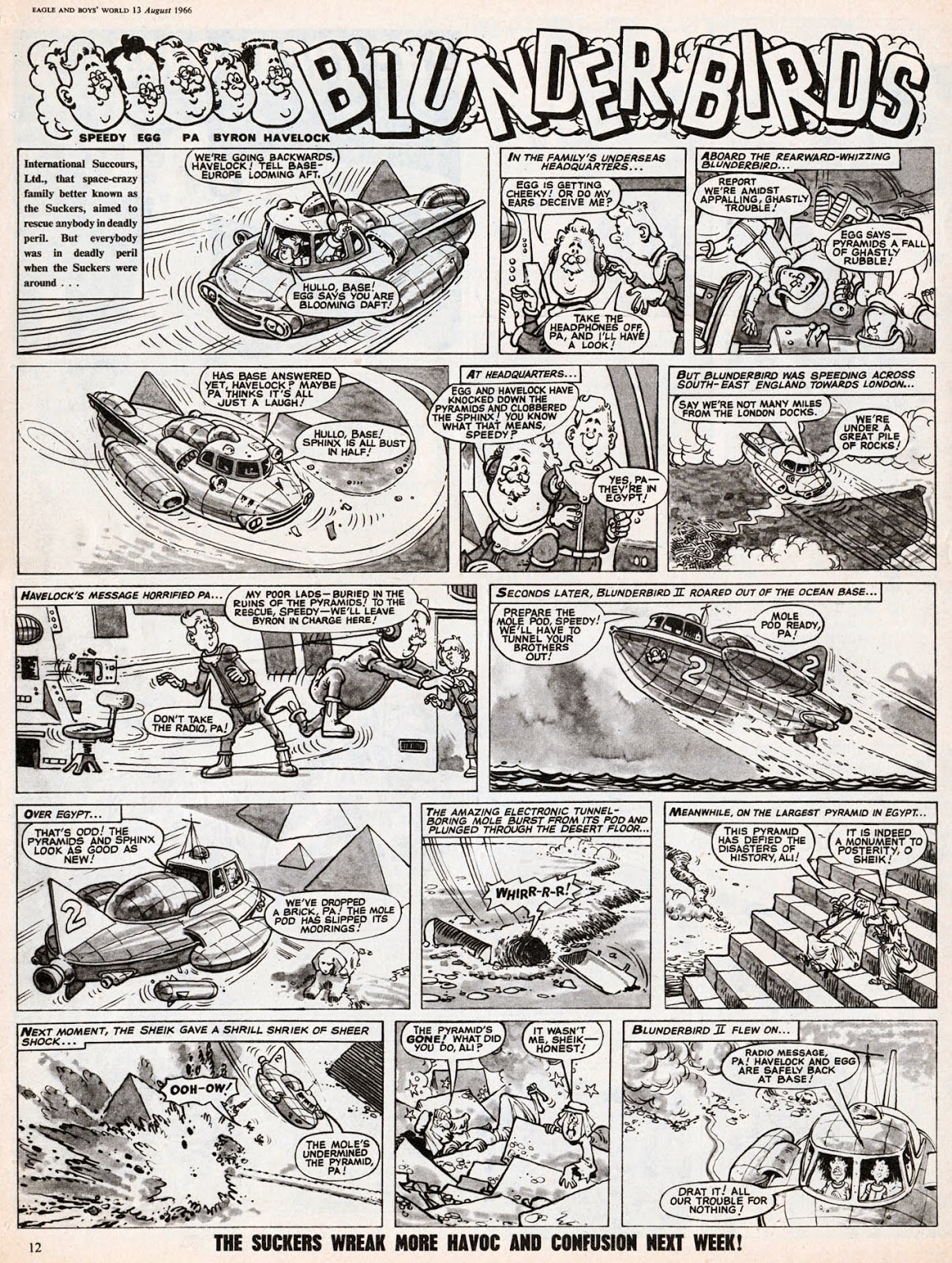
Blunderbirds (1966)

In the previous post I looked at Thunderbirds comic strips from over the years but there was also a parody strip, Blunderbirds, which ran in Eagle weekly for a short time in 1966. 

Illustrated by the excellent and versatile Brian Lewis, the one page humour strip only lampooned the basics of Thunderbirds rather than being a detailed spoof but it's still worth noting I think. And anything drawn by Brian Lewis is always worth a look.

This example is from Eagle and Boys' World  Vol.17 No.33, dated 13th August 1966, published by Odhams. Click on the image above to see it larger.   

Thứ Tư, 14 tháng 1, 2015

Thunderbirds in the comics


Unless you've been living on Mars (with those pesky Rock Snakes) you probably know there's a brand new Thunderbirds series coming to TV this Spring, entitled Thunderbirds Are Go. A mixture of CGI and models it promises to put a new spin on the old favourites but remaining true to the basics. 

What you may also know is that last October it was announced that DC Thomson will be publishing a monthly Thunderbirds Are Go magazine this year, plus an annual. Thomsons are being very hush-hush about it so there's no news on contents or publication date as yet but I'll post info as soon as I get the go ahead. (Although you'll probably hear of it elsewhere first.)

This isn't the first time there's been a Thunderbirds magazine of course. The series has a long association with comics, dating back to TV Century 21 No.52 in early 1966 (cover above) which featured the first Thunderbirds comic strip illustrated by the great Frank Bellamy...

The Thunderbirds strip replaced the Lady Penelope strip (which had been running in TV21 since issue 1 in January 1965). However this heralded a promotion, with Lady Penelope gaining her own weekly publication. 

Thunderbirds became a major part of TV21 but never had its own ongoing comic at that time, although in 1966 there was the Thunderbirds Extra, a 48 page glossy one-off which effectively was the first Thunderbirds solo comic...
The special featured several long complete Thunderbirds strips by a variety of top 1960s artists including Brian Lewis...

Don Harley...

...and Ron Turner...
There were other Thunderbirds specials and annuals of course, but I'm mainly focusing on the regular comics for this post. 

TV21's Thunderbirds strip ended in 1970. A year later, Polystyle gained the licence to publish strips based on Gerry Anderson shows and launched Countdown (see blog post here)...
A brand new Thunderbirds strip began in Countdown No.1, illustrated by Don Harley...

Countdown became TV Action in 1972 and its falling fortunes led to some reprint in its pages including Frank Bellamy Thunderbirds strips from TV21. TV Action later dropped the Thunderbirds strips before the comic ended in 1973 but nine years later in 1982 Polystyle published the Thunderbirds Special. This 48 page comic was all-reprint, gathering strips from various annuals and specials.
Presumably it sold well enough for Polystyle to publish two more Thunderbirds Specials in 1983 and 1984. Again, all reprint.

A few years later, in 1988, Action 21 was launched, published by David Nightingale of Engale Marketing in Blackpool (based at Lytham Road's excellent Thunderbooks comic shop). Superbly designed by Graham Bleathman, Action 21 was a 20 page A4 comic on quality paper, containing sharply reproduced reprints of TV21 strips including Bellamy's Thunderbirds. Sadly the limited distribution comic didn't last too long but it was a worthy exercise. (Back issues are still available from the publisher. Click here to see.)
In 1991, with Thunderbirds enjoying a revived surge of popularity for a new generation (due to repeats on TV), Fleetway launched Thunderbirds the Comic, a 24 page fortnightly edited by Alan Fennell who had been the original editor of TV21, as well as a writer on the TV series.
For its first three issues Thunderbirds the Comic only contained reprints of TV21 strips (plus great new cutaways by Graham Bleathman) but from issue 4 it began to include new material in the form of strip adaptations of TV episodes featuring fantastic artwork by people such as Steve Kyte and Keith Watson...


Thunderbirds the Comic was initially a massive success for Fleetway and ran for 89 issues, concluding in March 1995. Convinced there was still potential in the comic, Alan Fennell gained the licence to publish it himself as Thunderbirds Are Go! 
For a few issues it was cheaper than its predecessor but Thunderbirds Are Go! didn't survive for long. (I think it lasted 8 issues.) Its contents were once again TV21 reprints plus photo-strips using screen grabs from the TV series. (Unfortunately the quality of the photos wasn't too good in issue one, with some looking like they'd simply been photographed from the TV screen.)
In 1999 Redan launched their own Thunderbirds monthly magazine, with a slick design in tune with other Thunderbirds merchandise of the time.
The direction of Redan's Thunderbirds mag was distinctly younger than previous publications featuring the property. Its emphasis was on simply told photo-stories and activity pages (and new cutaways by Graham Bleathman)...

Undoubtedly this was a disappointment for older fans but it proved to be the right decision by Redan as the publication ran for several years. 

So... what will DC Thomson's new Thunderbirds Are Go magazine be like when it arrives on our shelves? The last 49 years of Thunderbirds comics (and indeed British comics in general) have shown a gradual simplification in tone. TV21 was very sophisticated compared to today's comics, but that didn't deter readers back in 1965. (I was five years old when TV21 No.1 was published. Loved it!) 

The old attitude in publishing used to be that if your comic was aimed at 5 to 11 year olds, you'd write it for the older end of the target audience and the younger ones would catch up (and feel 'big' that they were reading something that wasn't 'babyish') - because children will drop a comic like a stone if they think it's infantile. Publishers could take risks like that when sales were half a million or so. Today it's a different scene, with many children struggling with their reading, a culture with more emphasis on visuals, and publishers not wanting to risk alienating the ones who do pick up their mags. It's possible that Thunderbirds Are Go will follow the direction of Doctor Who Adventures and suchlike and have a focus on 'activity pages' and pull-out posters - and inevitably be bagged with gifts. We'll know soon enough. The good thing is that once again there'll be a Thunderbirds magazine in newsagents (hopefully with some comic strip). 

For a more detailed history of Thunderbirds comic strips see the excellently researched Technodelic website:
http://www.technodelic.pwp.blueyonder.co.uk/Upload01/Thunderbirds01.htm

UPDATE: I've just received this first image of the new character designs for the new series. What do you think, folks?