It's been a while since I looked at the 'golden age' of British comics so here's the cover to Chips No.2690, dated October 17th 1942. During those wartime years Chips (and many other comics) were published on alternate Wednesdays instead of weekly, so this is the issue that was published on Wednesday October 14th, 73 years ago.
The cover strip, Weary Willie and Tired Tim is by Percy Cocking, beautifully drawn and capturing the environment of those long-ago days. The final panel, as almost always, features a slap-up feed, but only for one of the comical tramps this time!
Hiển thị các bài đăng có nhãn Illustrated Chips. Hiển thị tất cả bài đăng
Thứ Tư, 7 tháng 10, 2015
Chủ Nhật, 14 tháng 6, 2015
CHIPS ANNUAL 1941
Although Illustrated Chips (or simply Chips as it was commonly known) ran from 1890 to 1953 (when it merged into Film Fun) it only spawned three annuals. There would have been more if World War 2 hadn't caused paper shortages, so the books dated 1939, 1940 and 1941 were the only ones published. I took a look at the 1940 edition a while back (see here) and now here are a few pages from Chips Annual 1941 that I bought a few months ago. The book would have been published in Autumn 1940.
With the weekly Chips only having black ink on pink coloured paper, the readers must have felt that the annual was really exceptional with its brightly coloured cover showing the regular characters having sneaked into the editor's office to raid his cigars and cakes. Note the bound collection of Chips hanging on the side of his desk. The publishers used to bind the issues into 26 issue (six monthly) volumes for their own in-house files. These volumes now turn up on eBay since the current copyright owners sold them off years ago.
The contents of these annuals published by Amalgamated Press were similar in format: 96 pages comprised of text stories and strips. Most, if not all, of the content was made up of reprints from the weekly. Some stories combined text and strips, such as this Millie Mascot two pager, most probably a reprint that had been reformatted...
The book provided readers with plenty of reading material in the form of illustrated text stories. Here are just a few examples...
The entire contents of the 1941 annual were in black and white except for a colour frontispiece, a Laurie and Trailer strip in red spot colour, and this four page full colour Weary Willie and Tired Tim strip. Going by the way the first sequence of events reach a natural conclusion on page two it's evident this is two weekly strips reprinted and rewritten as a four pager. Artwork by Percy Cocking.
I don't know who drew the Eagle Men Patrol adventure strip but I find the use of hatching and cross-hatching quite atmospheric and effective, albeit very dated looking these days.
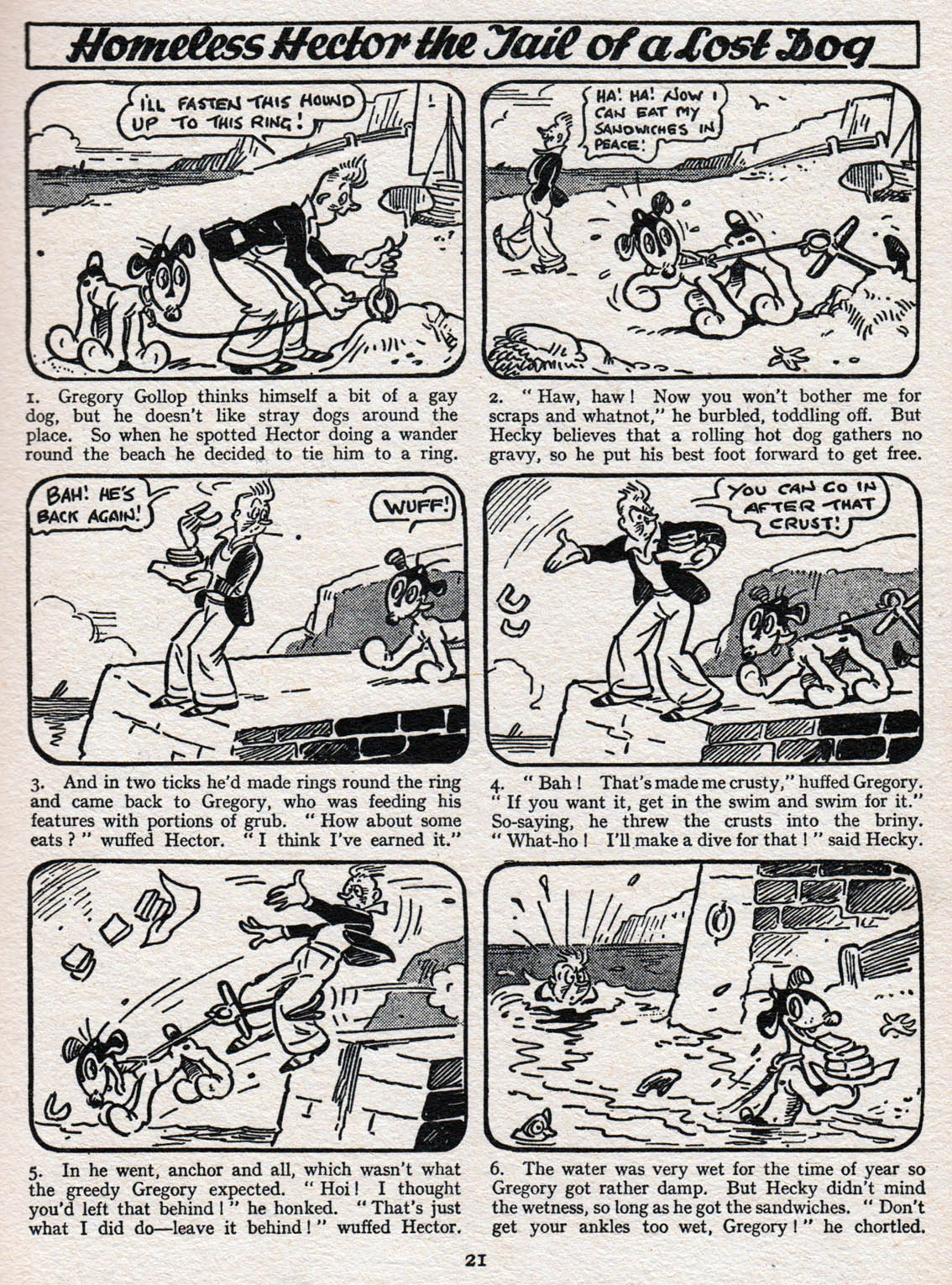
It wouldn't be Chips without long-running favourite Homeless Hector. In this story drawn by Bertie Brown, the stray dog gets revenge on cruel Gregory Gallop.
Another Chips favourite of course was Casey Court. Unless they've reformatted this from a half pager I think it may have been drawn specially for the annual. Art by Percy Cocking, who includes Willie and Tim as guest stars...
At the end of the book, the editor signs off with a plug for the weekly. Although it would soon become a fortnightly for the duration of the war and sometime afterwards. Sadly this was goodbye to the Chips Annual as no more were produced.
On the back cover, a nice extra in the form of a game.
These old annuals were nearly an inch thick, giving the impression of much more content than modern annuals. In truth, they had 96 pages but the paper stock was far thicker than that used in today's 112 page Beano Annual.
Thứ Năm, 8 tháng 1, 2015
Alfie the Air Tramp
![]() |
| It's probably not intentionally symbolic. |
Humourous tramps had been a staple feature in British comics since the debut of Weary Willie and Tired Tim in Chips in the late 19th Century. Many imitations followed, often with variations on the theme. Combining a funny tramp with aviation was inevitable. It was a good strip though, thanks to inventive scripts and the artistry of John Jukes who drew many of the strips.
Here are a few examples. (Click images to see them much larger.) Firstly from 1934 when Alfie the Air Tramp was the regular cover star of The Joker...
Now a few from 1942 from the combined Chips and The Joker, although I think one or two of these may be reprints. Even as popular as he was, Alfie was never going to replace Weary Willie and Tired Tim from their established cover position but he did manage the next best thing, appearing on the back cover of the comic instead...
Great slapstick strips from a bygone age. Anyone interested in seeing more 1930s/40s classic characters sometime? Or don't they float your boat? Leave a comment and let me know.
Chủ Nhật, 27 tháng 4, 2014
BATSOWL - The British Batman of 1918
As most of you will know, this year marks the 75th anniversary of Batman. However, the notion of costumed 'bat-men' didn't originate with Bob Kane's creation. One such earlier character was Batsowl, who starred in a series of prose stories in the British comic Illustrated Chips in 1918.
I'm not suggesting for a moment that there was any connection of course. Bob Kane was born in 1915, so it's highly unlikely he'd have seen a British comic when he was three years old. However, there are some interesting similarities between the two characters, not least being the costume, as you can see from the header illustration above.
Like Batman, Batsowl's other identity was a wealthy figure. In this case, an Earl, Desmond Devance...
He also had a secret underground laboratory, not dissimilar to the Batcave...
...and his appearance struck terror into people...
Sadly, like most British comics of the time, Batsowl is uncredited. I don't know how long the serial ran as I only have one episode, which is the one I'm showing here. It's from Illustrated Chips No.1477, dated December 21st 1918. This was one of the comics presented as a facsimile in 1972 in the Six Comics of World War One collection. (More info about those comics here.)
It's highly likely that both Batman and Batsowl were both partially influenced by The Phantom of the Opera, written in 1909, and The Scarlet Pimpernel (which was adapted as a very popular London play in 1905).
Click on the image below to read this chapter of Batsowl and see the 'British Batman' for yourselves...
Đăng ký:
Bài đăng (Atom)


.jpg)