Hiển thị các bài đăng có nhãn Bertie Brown. Hiển thị tất cả bài đăng

Chủ Nhật, 14 tháng 6, 2015

CHIPS ANNUAL 1941

Although Illustrated Chips (or simply Chips as it was commonly known) ran from 1890 to 1953 (when it merged into Film Fun) it only spawned three annuals. There would have been more if World War 2 hadn't caused paper shortages, so the books dated 1939, 1940 and 1941 were the only ones published. I took a look at the 1940 edition a while back (see here) and now here are a few pages from Chips Annual 1941 that I bought a few months ago. The book would have been published in Autumn 1940.


With the weekly Chips only having black ink on pink coloured paper, the readers must have felt that the annual was really exceptional with its brightly coloured cover showing the regular characters having sneaked into the editor's office to raid his cigars and cakes. Note the bound collection of Chips hanging on the side of his desk. The publishers used to bind the issues into 26 issue (six monthly) volumes for their own in-house files. These volumes now turn up on eBay since the current copyright owners sold them off years ago. 

The contents of these annuals published by Amalgamated Press were similar in format: 96 pages comprised of text stories and strips. Most, if not all, of the content was made up of reprints from the weekly. Some stories combined text and strips, such as this Millie Mascot two pager, most probably a reprint that had been reformatted...


The book provided readers with plenty of reading material in the form of illustrated text stories. Here are just a few examples...


The entire contents of the 1941 annual were in black and white except for a colour frontispiece, a Laurie and Trailer strip in red spot colour, and this four page full colour Weary Willie and Tired Tim strip. Going by the way the first sequence of events reach a natural conclusion on page two it's evident this is two weekly strips reprinted and rewritten as a four pager. Artwork by Percy Cocking.  


I don't know who drew the Eagle Men Patrol adventure strip but I find the use of hatching and cross-hatching quite atmospheric and effective, albeit very dated looking these days.


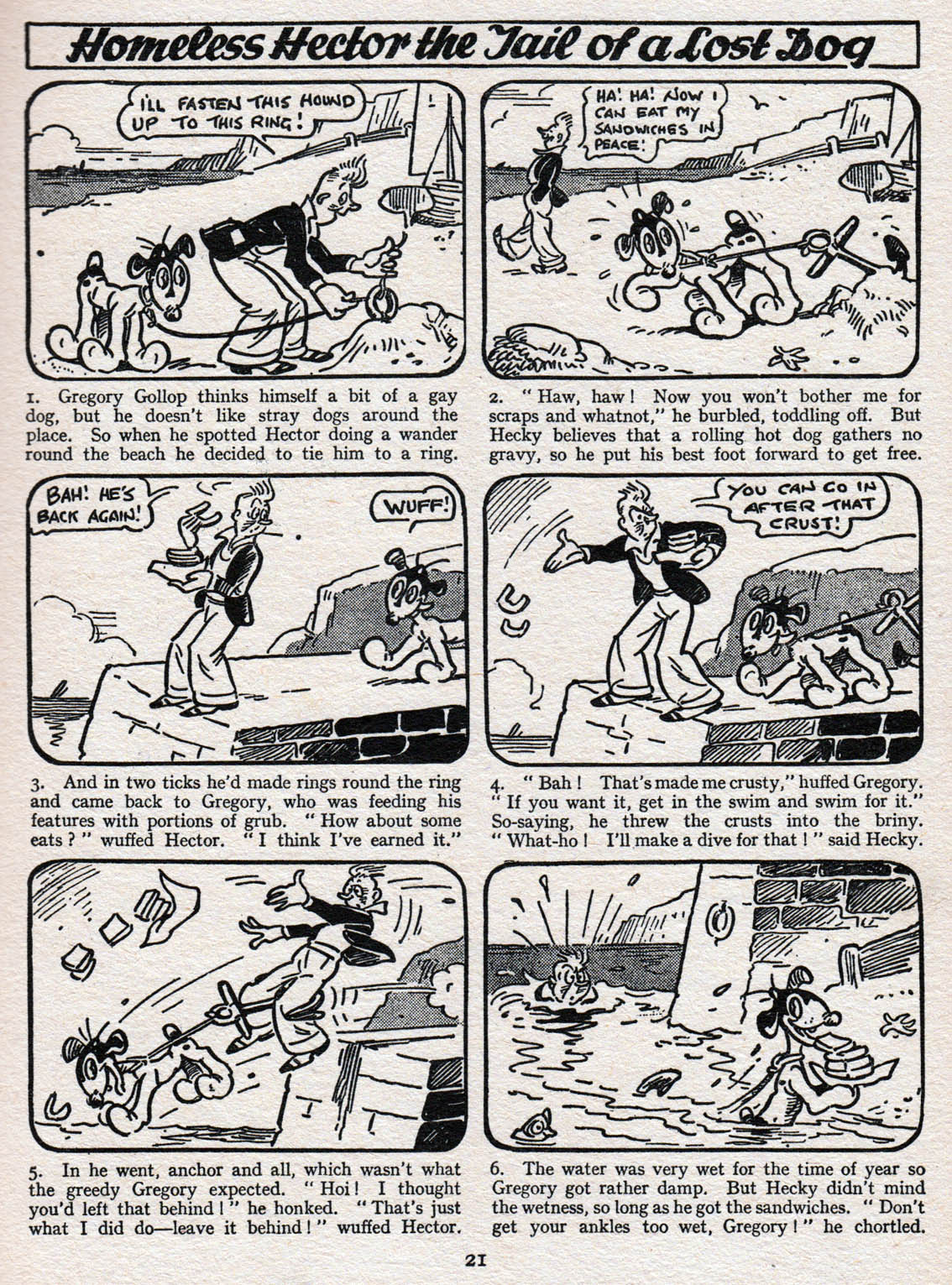
It wouldn't be Chips without long-running favourite Homeless Hector. In this story drawn by Bertie Brown, the stray dog gets revenge on cruel Gregory Gallop.
Another Chips favourite of course was Casey Court. Unless they've reformatted this from a half pager I think it may have been drawn specially for the annual. Art by Percy Cocking, who includes Willie and Tim as guest stars... 

At the end of the book, the editor signs off with a plug for the weekly. Although it would soon become a fortnightly for the duration of the war and sometime afterwards. Sadly this was goodbye to the Chips Annual as no more were produced.

On the back cover, a nice extra in the form of a game. 

These old annuals were nearly an inch thick, giving the impression of much more content than modern annuals. In truth, they had 96 pages but the paper stock was far thicker than that used in today's 112 page Beano Annual. 

Thứ Ba, 3 tháng 2, 2015

T.V. Fun No.1 (1953)

T.V. Fun No.1. Cover date: September 19th 1953. 
Price: 3d (1p). Every Monday (but probably out the previous Saturday.)
Publisher: The Amalgamated Press Ltd.
Page count: 20, comprising of four full colour, four spot colour (red), 12 black and white.
Page size: 24cm wide by 32cm high. 
Print quality: newsprint.

The year 1953 was a turning point for The Amalgamated Press. In one fell swoop they axed their three longest running comics. Comic Cuts, Illustrated Chips, and Wonder (formerly The Funny Wonder) were all cancelled in the same week, and replaced the following week with a brand new comic, TV Fun.

Clearly A.P. were determined to appear up-to-date by jettisoning their oldest comics in favour of one that reflected the new television age. Comic Cuts and Chips had run for over 60 years. Would TV Fun prove to be a worthy successor? Sadly not. It survived for just six years, changing its title to TV Fan for its last few months and merging into the romance comic Valentine in 1960.

Truth be told though, TV Fun wasn't a bad comic by any means. It was perhaps just not as modern-looking as A.P. would have hoped, despite its full colour covers (which the extinguished comics had lacked). To its credit it did feature work by some of the top artists in British comics, so let's look at a few pages from issue one. 

On the cover (above), the Arthur Askey strip had sort of made the jump from A.P.'s Radio Fun to herald this new venture. The artwork is by Arthur Martin.

Turning the page, the first thing the reader would be confronted with was a two page text story As Midnight Chimes. Prose stories like these were still a common feature of comics of the 1950s. 
Panel shows have always been a staple part of the TV schedules (because they're relatively cheap to do) and TV Fun reflected that with Put Your Question. I thought this was the work of Cyril Price but I'm reliably informed by comic historian Ray Moore that it's by Alex Akerbladh, and the last series he drew for A.P.
TV Fun contained a good balance of humour strips, prose stories, and adventure strips. One of the latter being Call In The Yard...
No less than five prose stories appeared in the comic. One of them was a complete story featuring super-spy Valda...
An adventure strip was awarded the full colour centre pages, with chapter one of The House With Red Shutters illustrated by George Heath...

The excellent Roy Wilson had a place in the new comic too, with two strips on page 14: Who's Who in Our Zoo, and Hoofer the Tee Vee Gee Gee. Neither of which were actually TV characters but TV Fun seemed to be aiming for the essence of a TV show in some of its strips, rather than filling it with adaptations. 
However, a TV celebrity did appear on the facing page in the form of Jimmy Edwards. Artwork by Reg Parlett, packing a lot into the page...
Despite this being a new comic and the company's big new launch, the editorial didn't appear until the inside back page, tucked away at the bottom. There the editor welcomed the readers, told them of things to come, and recounted his week. Which is all well and good until he cracks a racist joke. 
On the back page, a full colour strip starring Diana Decker 'The Cutie Queen of the TV Screen'. Judging from the times Ms.Decker flashes her legs in this and subsequent strips I think it's fair to say that A.P. were aiming TV Fun at an older reader than Thomson's Dandy and Beano. It looks to me that Bertie Brown was the artist of this page, and well chosen too for his ability to draw the female figure. 
Surprisingly (to me at any rate) I won this first issue on eBay last week for just £9.99. Either not many people noticed it or interest in pre-1960s British comics is waning fast. Of course, many collectors buy for nostalgia, and anyone who had this comic as a child would be in their late sixties by now and most likely to be cutting back on their collection rather than building it up. I hope showing a few pages from it here have been of interest to readers of this blog anyway. 

As always, click on each page to see it at a larger and more legible size.

Thứ Bảy, 10 tháng 5, 2014

This week in 1938: BUTTERFLY


Several British comics have been known to be named after ferocious beasts; Eagle, Lion, Tiger, Jag.... er, Butterfly!? Yes, Butterfly seems to have been an unusual title for a comic but it didn't harm its fortunes, with it running 1,206 issues from 1925 to 1940.

The issue shown here is No.1,101, dated May 14th 1938, but published on May 10th, 76 years ago today. The topline announces "Grand News For All Readers", but this wasn't the sort of "grand news" that often meant a merger. It was simply an announcement of a new story due to start the following week.

The cover strip, Smiler and Smudge, was drawn by Bertie Brown. Unfortunately, reflecting the times, 'Smudge' is presented as a stereotypical caricature of a black boy both in appearance and speech. He's also subservient to his white co-stars. Although Smiler and Smudge are pals, it's clear who's the boss. It's a nice example of Bertie Brown's artwork but there's little else to recommend it.

Butterfly had the same format of most other tabloid-sized comics of the day published by the Amalgamated Press. Eight pages, comic strips on pages 1,4,5, and 8, and text stories on pages 2,3,6 and 7. All in black ink on coloured paper (in Butterfly's case, green). Here's a few strips from the centrespread...

Captain Plus and Major Minus. Not sure who the artist is:

Honey Potts. Art by Roy Wilson:

Moggie the Mouser. Originally by Roy Wilson but I don't think this episode is. It's interesting that the character was created in 1936, pre-dating The Dandy's Korky the Cat by a year.

On page six, a typical A.P. text story, Sardura the Bold, sharing the page with the editor's letter, an advert for Sports Budget story paper, and an ad claiming that a bar of Cadbury's chocolate will give you "enough energy to let you run three miles and not feel tired"! What a huge difference to today, where chocolate is no longer allowed to be advertised in comics because it causes obesity!

On the back page, the only adventure strip in the comic; Jungle Island. (I don't recognise the artist, sorry.) Serials featuring British characters a faraway setting were the norm in comics of the time so each story needed its own novelty. In this case, it's Banjo Joe, who seems to have an annoying knack of strumming his banjo during life or death situations. No doubt the plucky musical instrument saves the day at some point. 

...and that's another look back at a comic from bygone years. Please let me know in the comments below if you enjoy looking back at these pre-war titles. I know a lot of comic fans prefer the titles of their own childhoods, but I think it's important to make sure the history of British comics, for better or worse, isn't forgotten. What do you think?