Here's a link to the short official showreel of the International Comics Expo; the excellent convention I attended in Birmingham the other week. If you weren't there, it'll be a quick taster of what you missed, and if you were there you might spot yourself. https://www.facebook.com/529276490479928/videos/882764175131156/
Saturday 6th May 1978 saw the publication of IPC's new sci-fi weekly Starlord in newsagents across the UK. The new comic was a companion to 2000AD and was originally planned as a monthly until IPC got cold feet, resulting in some quick changes before launching as a weekly. As one IPC editor told me a few years later, monthly comics were considered too risky back then. The concern was that the young target audience who were accustomed to weekly comics would either forget which week a monthly would come out, or even lose interest during the four week wait for the next issue. Of course that attitude changed over the years as UK publishers had to rethink the frequency of their comics in the wake of ever decreasing sales to give them a longer shelf life. These days a monthly frequency is the norm, with weeklies being the oddities. Anyway, back to Starlord No.1. The 32 page comic was on slicker paper than its sister title 2000AD and boasted more colour and better printing. It was also a few pence more expensive at 12p an issue. What it had in common with 2000AD was its presentation of stories in a dynamic and hyperactive fashion. For example, upon opening issue 1, the reader was immediately plunged into the relentlessly fast-paced Planet of the Damned by 'R.E.Wright' (Pat Mills) and Lalia. Here's the first two pages of the six page first episode which used the then-popular story theme about the 'Bermuda Triangle'...
Next came the first chapter of Time Quake, written by Jack Adrian with fantastic artwork by Ian Kennedy. Here's the first three pages...
Next, time for a breather and for the comic's fictional editor Starlord to introduce himself with art by Ian Gibson and an editorial dripping with paranoia...
The facing page showed the six alternative free badges, one of which was randomly attached by tape to the cover. If the readers weren't already jittery from Starlord's warning of imminent alien invasion the advisory about sticking the badges onto flesh would have completely pushed them over the edge: "you could develop a skin disorder, putting you out of combat"!
Here's one of those very badges, designed by Kevin O'Neill...
Across the centre pages, the first episode of Strontium Dog, by T.B. Grover (John Wagner) and Carlos Ezquerra. A popular character still around today in the pages of the latest 2000AD. Here's the first two pages...
Rounding off the issue was the longest story, Ro-Busters, running to 11 pages! This was one of the strips originally intended for the monthly, which accounted for its length. Subsequent chapters would be half the size.
Script by Pat Mills, artwork by Carlos Pino. The war robot Hammerstein still appears today in 2000AD's A.B.C. Warriors and Savage strips, with Pat Mills having connected several of his series into one universe.
Starlord wasn't a big success for IPC and sadly ended after 22 weeks, merging into 2000AD. Apparently 2000AD's sales were not good either, but it's thought that Starlord was sacrificed because it was more expensive to produce. On a positive note, the merger did 2000AD a lot of good, bringing in Ro-Busters and Strontium Dog which strengthened the comic. *************** While I'm at it, here are the covers to issues 2 and 3, plus the free gifts. No.2 was drawn by Brian Bolland, relating to the Time Quake story inside...
...and No.3 sported a fantastic cover by Kevin O'Neill...
The free gift in No.2 was the 'Space Calculator', a cardboard slide which gave information on the planets of our galaxy. No.3's freebie was a 'Starblast' game; a variation of 'Battleships', with a wipe-clean laminated card that could be re-used.
For more information on the background of Starlord comic, check out the book Thrill-Power Overload by David Bishop and, if you can find a copy, the now-out-of-print Beyond 2000AD from Hibernia Comics.
Back in 1977, before the Pet Shop Boys hit the music charts, Neil Tennant was Editor-in-Chief at Marvel UK. The company was putting out a various number of weekly comics at the time, reprinting Marvel strips from the USA, and basically trying to flood the market to rival IPC and DC Thomson. However, several reprint titles had failed or at least not had the longevity expected of them, and so something different was required. DC Thomson had made a success out of their all-war weekly Warlord, and IPC had followed suit with Battle Picture Weekly, which became another hit. Allegedly Neil Tennant felt that Marvel UK needed a war comic to compete in this area. The result was Fury. Marvel's war weekly was modelled so closely on Warlord and Battle that even the logo was obviously inspired by those of its rivals...
The covers of Fury were also similar to the ones Battle had been running. Powerful images with a punchy message. None punchier than the brilliant one shown at the top of this post by Carlos Ezquerra. The artist had produced many similarly strong images for Battle's covers so it was quite a coup for Marvel UK to commission him for Fury. Unfortunately, the company were not given a budget by their American owners to produce British strips so although Fury looked like a traditional UK war comic on the outside, the interiors were a different matter. With no option but to use American reprint material, Tennant chose to serialise Sgt.Fury and His Howling Commandos as the main strip, with each 20 page story spread across two or three weekly instalments. Art by Dick Ayers...
The same applied to Captain Savage and His Leatherneck Raiders, which had been a short-lived Marvel strip from the late sixties with art by John Severin...
The rest of the 32 page weekly was taken up with five-page complete war stories from Marvel comics of the 1950s. Some of which were looking quite dated by 1977. The Jap Trap is from 1959, art by Jay Scott Pike...
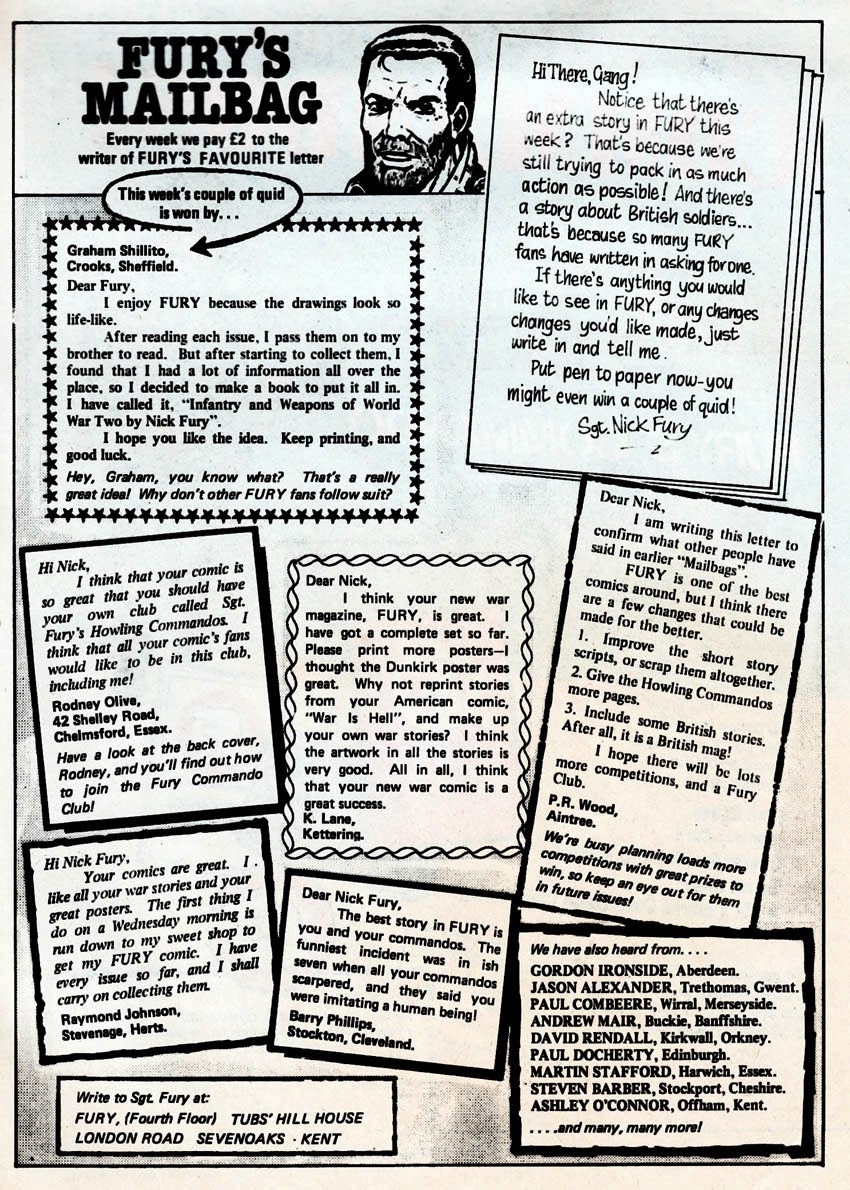
Despite its American content, Fury tried hard to be as close to a traditional British weekly as possible, such as running a letters page 'hosted' by Sgt.Fury himself...
...and following in the footsteps of Bullet's Fireball Club, Fury encouraged its readers to send in 30p for items such as a club badge, Identity Card, and Secret Codes...
Sadly, Fury failed to attract as many readers as its rivals, probably because the content just wasn't traditional enough. Had Neil Tennant been given free reign to develop a truly British war comic then perhaps it would have lasted longer. As it was, Fury ended after just 25 weeks, merging into The Mighty World of Marvel. Tennant left comics to work for Smash Hits, and a few years later became a huge success in the music industry. ******************************* Incidentally, the cover to Fury No.1 was by Dave Gibbons and there's currently a copy for sale from Silver-Acre on eBay if you're quick! Click here!