Hiển thị các bài đăng có nhãn solano lopez. Hiển thị tất cả bài đăng

Thứ Ba, 19 tháng 5, 2015

SCORE 'n' ROAR No.1 (1970)

With their first new boys' adventure comic Scorcher having been established for several months, IPC launched another football weekly on Saturday 12th September 1970. Score 'n' Roar used the same gimmick that IPC's Whizzer and Chips had pioneered a year earlier; two 'rival' comics in one. 16 page Roar was inside 16 page Score and could be separated by opening up the staples.

Kicking off the new comic the first strip was Jack of United, superbly drawn by Barrie Mitchell. A fairly standard football strip about two rival brothers but the interesting thing was that the plot concerning Jack's brother Jimmy continued into his own strip, Jimmy of City, in Roar.

Unlike Scorcher's newsprint format, Score 'n' Roar had the benefit of expensive photogravure printing. This enabled an excellent reproduction of photographs and the comic took full advantage of this by including several feature pages. Score had its opinion page written by 'The Captain'. I'm presuming the chap in the photo may be the comic's editor Dave Hunt. Can anyone confirm or deny this?
Cannonball Craig was somewhat like Scorcher's Billy's Boots in that its star was a youngster who was useless at football until aided by artificial means. In Billy's case it was his magic boots, and in Craig's case it was... wait for it... nuclear irradiated bubble-and-squeak! The artwork on this first chapter is by Mike Western, but Mike White drew later episodes.

Here's how Roar was bound into the centre of Score...
Roar's first strip was the aforementioned Jimmy of City by Barrie Mitchell, continued from Jack of United in Score...
Roar had its own opinion page headed by 'The Inside Man'. I'm pretty sure that the photo is of Bob Paynter, group editor of IPC's humour comics. He was a bit greyer when I knew him but that was 14 years later. I doubt Bob actually wrote the column but comics often used photos of staff members in this way. 
The great Tom Kerr was on board, illustrating the two page Peter the Cat strip. The name was inspired by real-life goalkeeper Peter Bonetti who was nicknamed 'The Cat', but the strip is not about him. 
The centre pages featured Mark Your Man, an Agatha Christie style mystery involving a process of elimination of the suspects. Art on episode one by Geoff Campion, but John Catchpole drew later episodes...
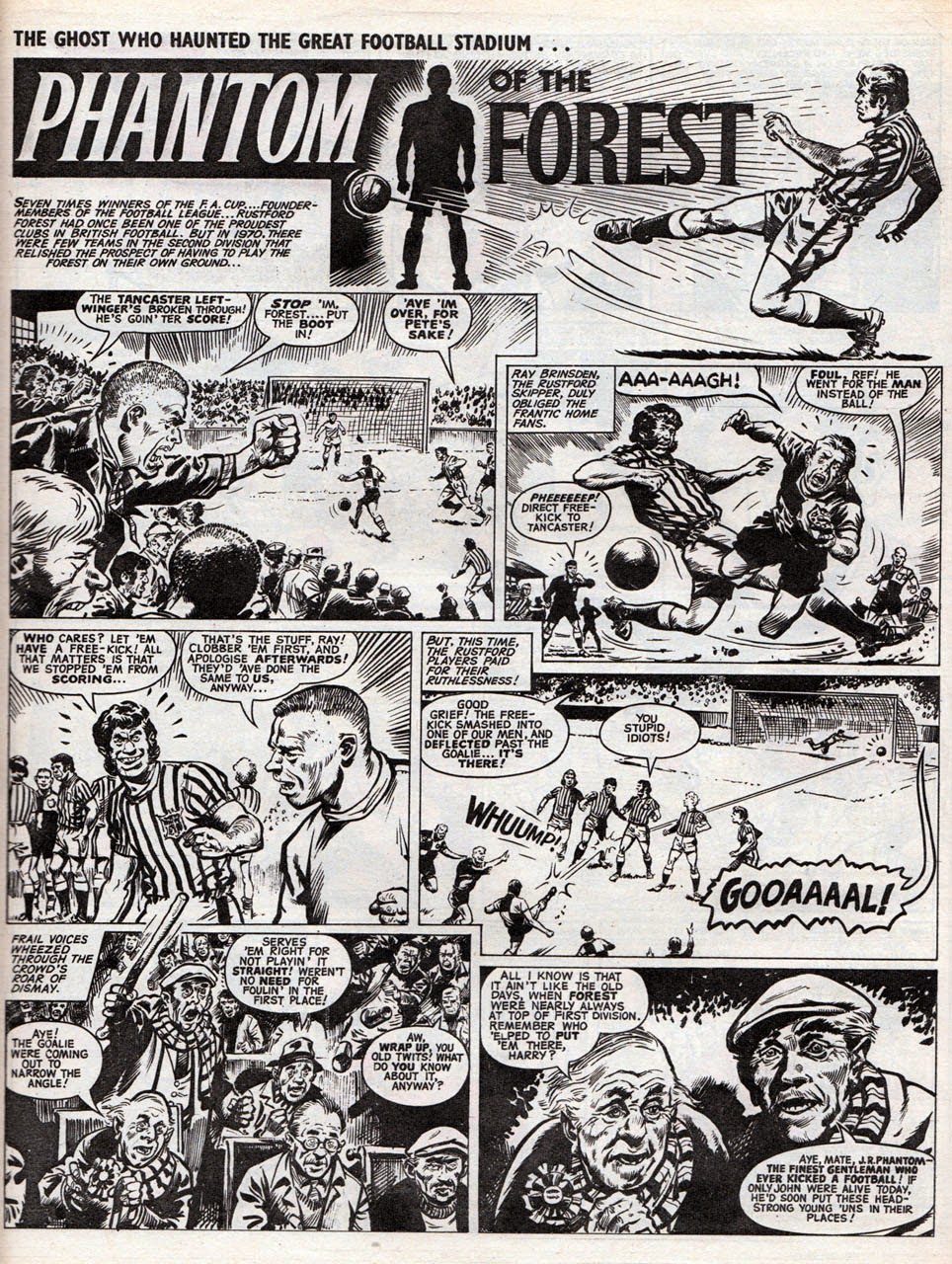
A supernatural three-pager next, with Phantom of the Forest about a ghost footballer. Art by Eric Bradbury, but Jesus Blasco drew later episodes. (I'm guessing that so many of the strips soon lost their original artists because the first episodes would have been produced many months earlier for the dummy issue and perhaps they couldn't fit the extra workload in regularly.)


The Mudlarks next, with art by Ted Kearon.
Back to the second half of Score for the next strip, and the one that was destined to become the most popular and enduring. Here's the very first episode of Nipper, illustrated by the Solano Lopez studio giving it a bleak, grimy look befitting the setting of the fictional industrial town it was set in. Nipper was actually written more like a story from a girls' comic, with an aspect of pathos and the underdog's struggle against his situation. He even had a cruel guardian. Clearly this touched a chord with readers and the strip survived for many years, transferring to Scorcher, and later Tiger, when the comics merged. I don't know who the writer was on these early Nipper strips but Nat Munger is a great name for a bad guy!  


After the grim despair of Nipper, the comic lightened things up for its last strip with Lord Rumsey's Rovers, a comedy drama drawn by Douglas Maxted (although another artist soon took over in subsequent weeks).
Overall, I felt that Score 'n' Roar was a better comic than Scorcher. Its stories seemed stronger and the better paper enabled good photo features. It soon added a humour strip, Trouble Shooter by Graham Allen, and you can see an example of that on a post I did seven years ago (click here). Sadly the comic didn't survive for long. Its paper quality declined and merged with itself in 1971, dropping the Roar part of the title, and then Score merged into Scorcher with the issue dated 3rd July 1971. 

Thứ Bảy, 11 tháng 4, 2015

Valiant and Smash! Summer Special 1971

Although not as slick or colourful as DC Thomson's Summer Specials, the rival products by IPC in the early 1970s were great value for money. Here's the evidence in the form of the Valiant and Smash! Summer Special published in 1971; 96 pages packed with strips old and new, with a striking cover by the great Mike Western. Let's look at a selection of pages...

Inside, there were extra-length stories of favourites from the weekly, such as a six page strip of His Sporting Lordship. Douglas Maxted was the artist on the weekly strip but specials often used replacement artists and in this case Jack Pamby turned in an excellent job... 

Similarly, on The Ghostly Guardian, regular artist Julio Schiaffino was replaced by Bill Lacey (father of humour artist Mike Lacey)...

One original artist who did draw the Summer Special version of his strip was Ken Reid, producing a nice two page Banger and Masher...


For budgetary reasons the IPC specials contained a lot of reprint, but readers didn't mind if we hadn't seen the stories before. A 1960s Karl the Viking serial from Lion was edited and recycled as a 16 page Erik the Viking epic. Artwork by Don Lawrence...

The specials also stretched out the budget by including features and prose stories. Here's the first page of a one-off story entitled The Radar Men, illustrated by Eric Bradbury...

A new Raven of the Wing six pager was included. I'm not sure of the specific artist but it looks like it may be by the Solano Lopez studio but possibly not by Lopez himself. (The kids in the bottom left hand corner don't look like his style.)

Only 8 of the 96 pages were in colour, two of which were given to The Swots and the Blots. Although the header (taken from the weekly) was by Leo Baxendale the strip itself in this instance was drawn by Les Barton...


The Special concluded with a nice lengthy 18 page Kelly's Eye strip by Solano Lopez. This was a revised reprint from a serial that had run in the weekly in 1964/65.

This edition and numerous other IPC specials provided hours of entertainment in the school holiday periods back then. Over the years the page count reduced from 96 to 80 then to 64... and even down to 48 in some cases, with the cover prices getting higher. That initial period of 96 page Specials certainly provided the best value for money. Happy times!

Thứ Bảy, 25 tháng 10, 2014

Britain AD2170 (LION 1970)

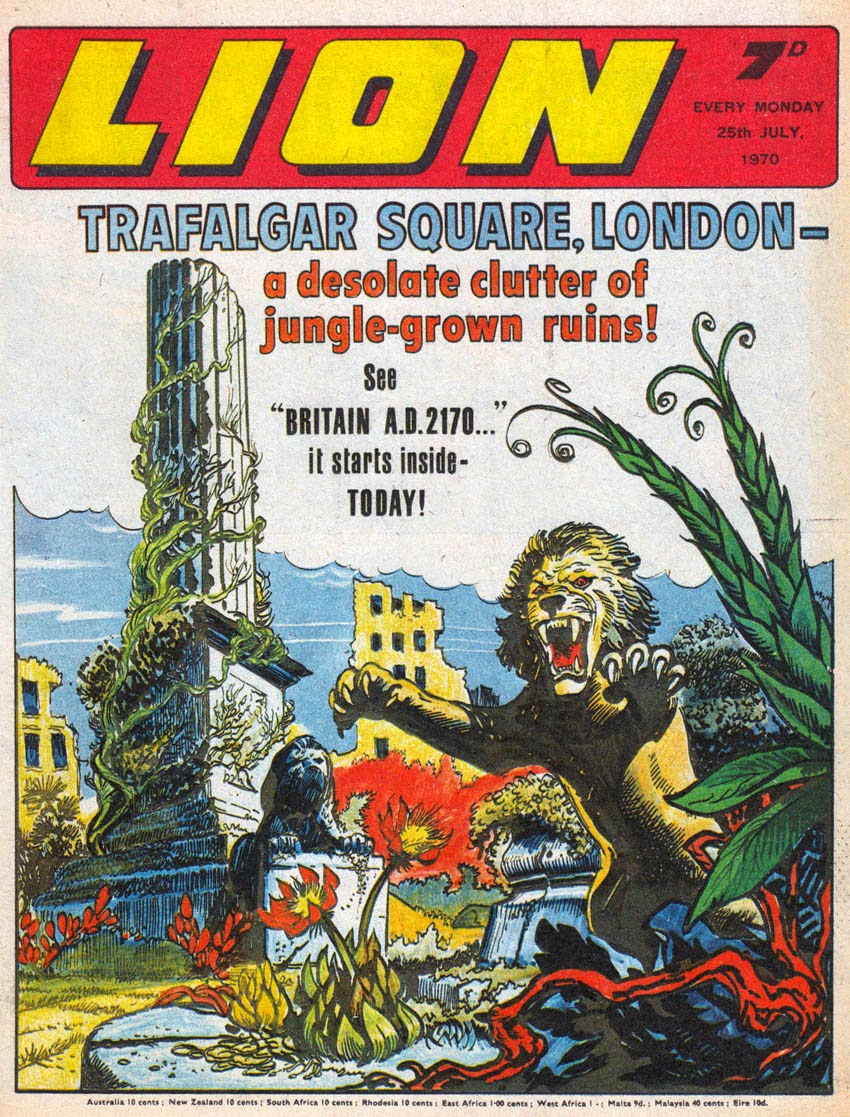
Tonight's episode of Doctor Who (In the Forest of the Night) reminded me in some ways of a short lived strip that ran in Lion weekly back in 1970/71, particularly the cover shown above (drawn by Geoff Campion). 

Britain AD2170 began in Lion dated 25th July 1970. A three page serial illustrated by Solano Lopez (and possibly his studio assistants) it told the story of four British astronauts who return to Earth after a five year mission. They discover that Earth is covered in a dense jungle and people have reverted to a primitive state. Borrowing an explanation from Planet of the Apes, the story proposes that the ship must have travelled into the future and that they've actually arrived in the year 2170.

Here's the first episode. Click pages to see them larger...


As in tonight's Doctor Who, London is overgrown with trees and vegetation and wild beasts are on the prowl. We learn that society has broken down into tribes, one of which are the savage 'Snakemen' who wear armour made from car tyres. They appear on the cover to Lion dated 22nd August 1970, drawn by Geoff Campion (who was illustrating most of Lion's covers at this time)...

The astronauts use the remnants of civilisation to fight the Snakemen but there's a greater danger from a huge scaly Godzilla-like monster that roams London, although how and where it originated isn't really explained.

Along with Smash!, Buster, Valiant, and some girls' titles, Lion hit a glitch in late 1970 due to a printer's strike. The issues dated November 14th were the last for several months, and the comics vanished from the shelves until the ones dated 6th February 1971. As with all the other serials, Britain AD2170 continued from where it had left off but the strike had affected sales of the comics. Lion and Thunder were set to merge, and so in the issue of Lion dated 13th March 1971, Britain AD2170 was brought to a conclusion. Here's the final episode...


Britain AD2170 wasn't one of the greatest strips to have appeared in a British comic but it had its moments and was suitably exciting. Personally I found Lion to be one of the better UK adventure comics of the seventies and was a good comic to lay the foundations for 2000AD a few years later. I'll be blogging more about Lion in future posts when I have time, hopefully before the year 2170.