Thứ Sáu, 16 tháng 5, 2014

This week in 1966: HULK SMASH!

It was 48 years ago today when Odhams Press Ltd. began their association with Marvel Comics by publishing reprints of The Incredible Hulk in the pages of Smash!

Yes, I know some sources claim that reprints of The Fantastic Four began in Wham! first, but that's not true. (Trust me. I have the comics. The FF came to Wham! a little later.) It was the issue shown here, Smash! No.16, dated 21st May 1966, that was the first Odhams weekly to feature a Marvel reprint.

Curiously, they started by reprinting Incredible Hulk No.2 rather than the first issue, but what a great choice! The opening image of the Hulk emerging from the swamp (by Jack Kirby and Steve Ditko) was a perfect and powerful way to introduce the character to British readers. (Parts of Hulk No.1 were reprinted in following weeks, and the origin chapter in Fantastic in 1968.)

The original Incredible Hulk comics (and his following appearances in Tales to Astonish) had been available in some UK newsagents but distribution was unreliable. The reprints in Smash! were the ideal way to showcase a consecutive run of Hulk stories and, for many of us, were our first discovery of the character.

Due to the page size of British comics being considerably bigger than American comics, panels from the Hulk stories were arranged to fit more onto each page. This first appearance of the Hulk ran to six pages in Smash!, - roughly 11 pages of the American comic. 

The editorial in the letters section gave The Hulk a shout out, and encouraged readers to hold on to this issue...

What else was in this landmark issue? Well, some excellent new British material, that's what! Let's have a look at a few highlights, starting with the brilliant Man from B.U.N.G.L.E. cover by Brian Lewis at the top of this post.

On pages 2 and 3 was the second chapter of a strip that had begun the previous week, - The Rubberman! Story by Ken Mennell with art by Alfredo Marculeta...


Ken Reid's Queen of the Seas is always worth showing here...


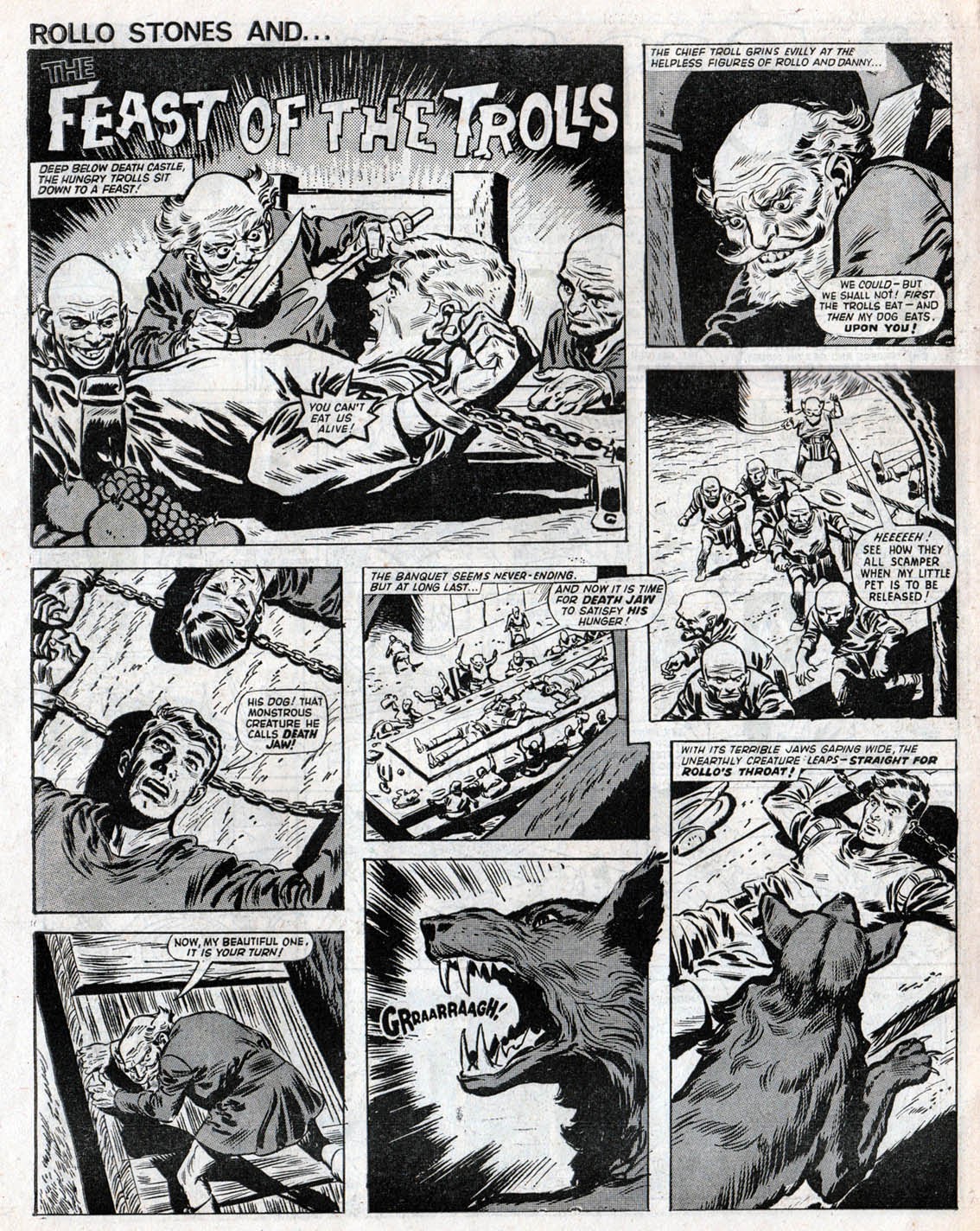
This next offering is The Legend Testers, although it had dropped its regular title that week to be called The Feast of the Trolls. And as I found out, you should never feed a troll. Excellent horror comic art by Jordi Bernet...


On the back page of this 28 page issue, Grimly Feendish. Artwork by Ron Spencer I think, or perhaps Mike Lacey. Someone ghosting Leo Baxendale's style anyway (but it's definitely not by Leo). 

These early issues of Smash! were some of the most entertaining comics of the sixties. Humour, horror, superheroes... it had the lot! I remember having a few issues of The Hornet and Victor around that time and thinking how mundane and ordinary it seemed in comparison. Admittedly, Smash! didn't sell as well as many of its rivals, but the more formalised comics have often been the most successful. Smash! had its own identity, as did its stablemates Wham! and Pow!, and they captured the mood of the times better than most other comics. Comics such as Valiant and Hotspur were better structured and slicker, but Smash! was cooler.

Thứ Năm, 15 tháng 5, 2014

Comics in the news


Just a brief post today to highlight a few items on comics that were in the national news this week. 

White Death, the 1998 graphic novel by Robbie Morrison and Charlie Adlard is set for a smart new reissue in August. The BBC News Scotland website recently interviewed the creators about the production of the book. A very interesting look behind the scenes of how a comic is put together:
http://www.bbc.co.uk/news/uk-scotland-27156304


The hugely successful Peppa Pig magazine for pre-school children was in the news on Tuesday. Its popularity has led to Disney to allow publisher Redan the license to package magazines featuring Mickey Mouse and Marvel Super-Heroes for the American market.
http://www.shropshirestar.com/shropshire-business/2014/05/13/disney-delight-for-peppa-pigs-shropshire-publisher/


...and finally, on Monday, London's Leicester Square was inundated by 250 X-Men cosplayers in an attempt to achieve the Guinness World Record for the largest gathering of X-Men characters in one place:


Thanks to Debbie Tate and Yel Zamor for the links. 

Thứ Hai, 12 tháng 5, 2014

Neil Tennant's FURY


Back in 1977, before the Pet Shop Boys hit the music charts, Neil Tennant was Editor-in-Chief at Marvel UK. The company was putting out a various number of weekly comics at the time, reprinting Marvel strips from the USA, and basically trying to flood the market to rival IPC and DC Thomson. 

However, several reprint titles had failed or at least not had the longevity expected of them, and so something different was required. DC Thomson had made a success out of their all-war weekly Warlord, and IPC had followed suit with Battle Picture Weekly, which became another hit. Allegedly Neil Tennant felt that Marvel UK needed a war comic to compete in this area. The result was Fury

Marvel's war weekly was modelled so closely on Warlord and Battle that even the logo was obviously inspired by those of its rivals...

The covers of Fury were also similar to the ones Battle had been running. Powerful images with a punchy message. None punchier than the brilliant one shown at the top of this post by Carlos Ezquerra. The artist had produced many similarly strong images for Battle's covers so it was quite a coup for Marvel UK to commission him for Fury. Unfortunately, the company were not given a budget by their American owners to produce British strips so although Fury looked like a traditional UK war comic on the outside, the interiors were a different matter.

With no option but to use American reprint material, Tennant chose to serialise Sgt.Fury and His Howling Commandos as the main strip, with each 20 page story spread across two or three weekly instalments. Art by Dick Ayers...

The same applied to Captain Savage and His Leatherneck Raiders, which had been a short-lived Marvel strip from the late sixties with art by John Severin...

The rest of the 32 page weekly was taken up with five-page complete war stories from Marvel comics of the 1950s. Some of which were looking quite dated by 1977. The Jap Trap is from 1959, art by Jay Scott Pike...

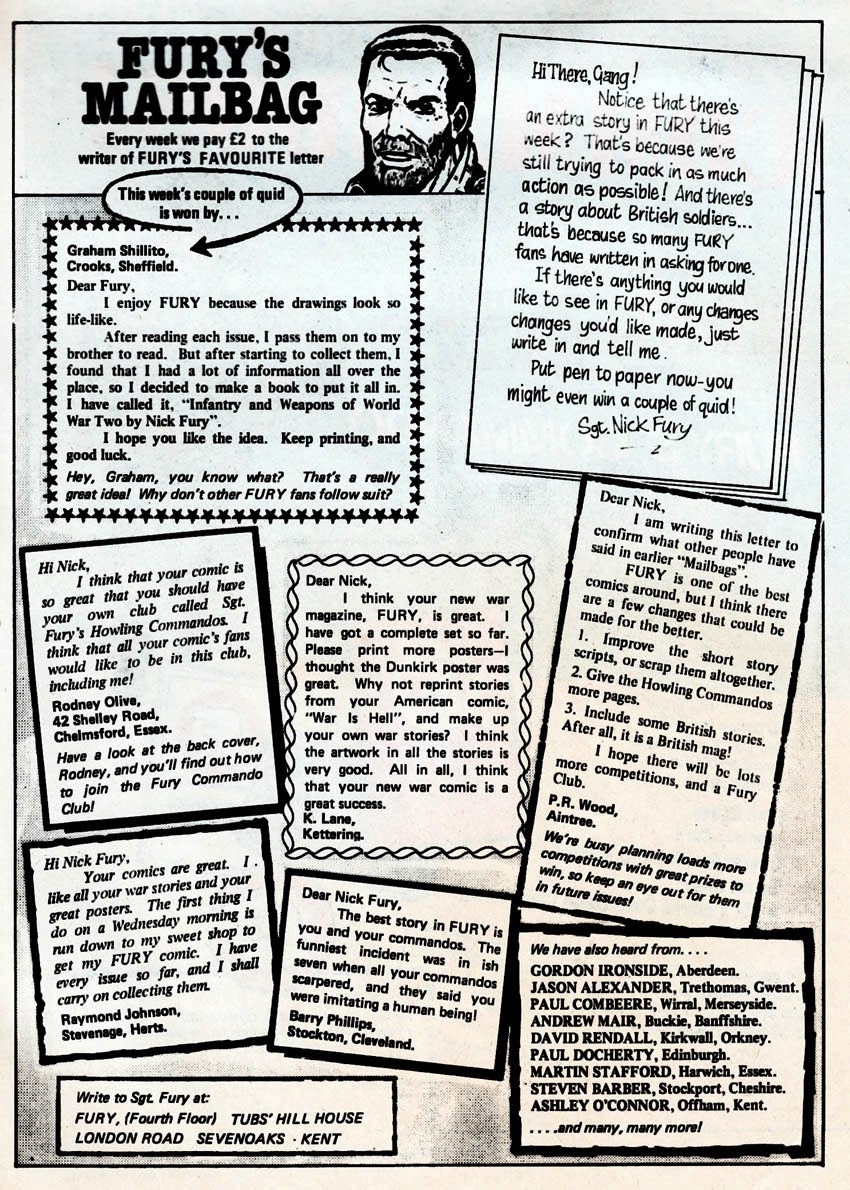
Despite its American content, Fury tried hard to be as close to a traditional British weekly as possible, such as running a letters page 'hosted' by Sgt.Fury himself...

...and following in the footsteps of Bullet's Fireball Club, Fury encouraged its readers to send in 30p for items such as a club badge, Identity Card, and Secret Codes...

Sadly, Fury failed to attract as many readers as its rivals, probably because the content just wasn't traditional enough. Had Neil Tennant been given free reign to develop a truly British war comic then perhaps it would have lasted longer. As it was, Fury ended after just 25 weeks, merging into The Mighty World of Marvel. Tennant left comics to work for Smash Hits, and a few years later became a huge success in the music industry.

*******************************

Incidentally, the cover to Fury No.1 was by Dave Gibbons and there's currently a copy for sale from Silver-Acre on eBay if you're quick! Click here!


Thunderbirds revisited

Browsing Amazon the other day I noticed that on August 28th, Egmont UK are scheduled to publish five softback Thunderbirds books reprinting classic stories from 1960s comic TV Century 21 featuring artwork by Frank Bellamy and others.

Each 48 page book utilizes cover art that was originally seen on the Thunderbirds the Comic fortnightly in the 1990s. 

I must admit to being surprised that these stories are being reprinted again so shortly after the Thunderbirds Comic Collection that was published last year, as these books seem to contain the same strips. That hardback is still available, and is actually a cheaper way to obtain the stories. However, it looks like these five softback books will be similar in format to European albums such as Tintin, so perhaps will be more enticing to children (and booksellers). 

Thứ Bảy, 10 tháng 5, 2014

This week in 1938: BUTTERFLY


Several British comics have been known to be named after ferocious beasts; Eagle, Lion, Tiger, Jag.... er, Butterfly!? Yes, Butterfly seems to have been an unusual title for a comic but it didn't harm its fortunes, with it running 1,206 issues from 1925 to 1940.

The issue shown here is No.1,101, dated May 14th 1938, but published on May 10th, 76 years ago today. The topline announces "Grand News For All Readers", but this wasn't the sort of "grand news" that often meant a merger. It was simply an announcement of a new story due to start the following week.

The cover strip, Smiler and Smudge, was drawn by Bertie Brown. Unfortunately, reflecting the times, 'Smudge' is presented as a stereotypical caricature of a black boy both in appearance and speech. He's also subservient to his white co-stars. Although Smiler and Smudge are pals, it's clear who's the boss. It's a nice example of Bertie Brown's artwork but there's little else to recommend it.

Butterfly had the same format of most other tabloid-sized comics of the day published by the Amalgamated Press. Eight pages, comic strips on pages 1,4,5, and 8, and text stories on pages 2,3,6 and 7. All in black ink on coloured paper (in Butterfly's case, green). Here's a few strips from the centrespread...

Captain Plus and Major Minus. Not sure who the artist is:

Honey Potts. Art by Roy Wilson:

Moggie the Mouser. Originally by Roy Wilson but I don't think this episode is. It's interesting that the character was created in 1936, pre-dating The Dandy's Korky the Cat by a year.

On page six, a typical A.P. text story, Sardura the Bold, sharing the page with the editor's letter, an advert for Sports Budget story paper, and an ad claiming that a bar of Cadbury's chocolate will give you "enough energy to let you run three miles and not feel tired"! What a huge difference to today, where chocolate is no longer allowed to be advertised in comics because it causes obesity!

On the back page, the only adventure strip in the comic; Jungle Island. (I don't recognise the artist, sorry.) Serials featuring British characters a faraway setting were the norm in comics of the time so each story needed its own novelty. In this case, it's Banjo Joe, who seems to have an annoying knack of strumming his banjo during life or death situations. No doubt the plucky musical instrument saves the day at some point. 

...and that's another look back at a comic from bygone years. Please let me know in the comments below if you enjoy looking back at these pre-war titles. I know a lot of comic fans prefer the titles of their own childhoods, but I think it's important to make sure the history of British comics, for better or worse, isn't forgotten. What do you think? 

Thứ Sáu, 9 tháng 5, 2014

Sharks! Robots!


Just a quick plug for my eBay sales this week. I currently have a couple of pieces on there, - original art for a complete Pathetic Sharks strip from Viz and a Robo-Capers from The Transformers. Black ink on Bristol Board.

Bidding ends on Sunday and all bids are much appreciated. Click here to go to my eBay page. Thanks for looking!

Thứ Năm, 8 tháng 5, 2014

Another four Commando comics hit the shops


Here's the info from DC Thomson on the four issues of Britain's longest running adventure comic Commando that arrived in newsagents this week...


Commando Issues 4703-4706 – On Sale 8 May 2014

Commando No 4703 – Attack In Artois
On the morning of the 28 June 1914 two pistol shots fired in a Sarajevo street had plunged the world into war and pitched men of all nations against one another.
   As shells ripped ground and air apart all around, a small ceasefire was called in No-Man's-Land while two men traded stories instead of lead for one had saved the other's life. Both had similar tales to tell, yet one was British, the other German…

Introduction
As a tribute to those who served during the years 1914-1918 — on the Home Front or at Front Line — Commando has produced a series of stories of characters caught up in the tumult of the First World War. None of them are real people but we’d like to think that the experiences they have will not be a million miles from what actually happened to so many.
   In the previous issue, our heroes were from the ANZAC and the Royal Navy, battling away in Gallipoli. As that campaign ground on, new offensive started on the Western Front in France — The Battle Of Loos in the Artois and Champagne region. The Tommies might have had tin hats now but that was the only improvement to their lot, for even the British were now using the dreaded poison gas.
   I hope you enjoy this and the other stories in the series as much as we have.

Calum Laird, Commando Editor

The series continues in four weeks with Firestorm In Flanders, Commando No 4711

Story: George Low
Art: Keith Page
Cover: Ian Kennedy


Commando No 4704 – Desert Hero

The “Phantom Major”…the “Battling Major”…every man in that company had a different name for him, and when he led them every man would fight to his last drop of blood.
   Not one knew that under his tunic with its Major’s crowns was plain Jack Steel, corporal. They wouldn’t have believed it. But then Napoleon was once a corporal…

Introduction

   Here’s another slightly misleading Commando cover. Not that there’s anything wrong with Ken Barr’s mighty illustration it’s just that…well, this isn’t the air story you might expect. Ah, but what a story, Mr Skentleberry! Classic Commando fare — a man who pretends to be something he’s not (despite the consequences) plus action, action, action. And what superb action illustrations, too, the pen and brushes of Alonso were seldom so well employed. Check out those faces, too — masterful stuff.
   Oh, and be prepared for a little twist at the end.


Calum Laird, Commando Editor

Desert Hero originally Commando No 144 (December 1964), re-issued as No 731 (April 1973)

Story: Skentleberry
Art: Alonso
Cover: Ken Barr


Commando No 4705 – Battler Hastings

Augustus “Gus” Hastings was the strict-but-fair headmaster of St. Sebastian’s school — an institution that had educated those destined for high military rank or government appointment for generations.
   With the Second World War raging, Gus and his pupils were packed off to the safety of Newfoundland. En route, however, they were caught up in a hair-raising adventure, tangling with Germans all the way.
   As time went on, the boys realised there was more to Gus than met the eye. And just where did he learn to fight?

Story: Alan Hebden
Art: Rezzonico
Cover: Janek Matysiak


Commando No 4706 – Seek And Sink

This is the story of the Fairey Swordfish torpedo dive-bomber…an out-dated biplane at first glance, yet still a very powerful weapon in the arsenal of the Fleet Air Arm. For, unlike many other planes, they could take a lot of punishment and still fly. Their crews scoured the seas, their mission to seek out and sink enemy shipping — often with spectacular results!

Introduction

In Commando we always have fictional characters but, for authenticity, they can be placed in real-life military organisations. The Royal Navy’s Fleet Air Arm gives us double the usual amount of scope — for a yarn that can encompass both a sea tale AND an aircraft story, in this case the Fairey Swordfish torpedo bomber.
   Author Ian Clark does this skilfully and delivers a script that manages to be thoughtful and thrilling. It’s dynamically illustrated by Ibanez, whose rain-drenched, stormy scenes on pages 9, 10 and 11 are not for the faint-hearted!

Scott Montgomery, Deputy Editor

Seek And Sink, originally Commando No 2255 (February 1989), re-issued as Commando No 3779 (January 2005)

Story: Ian Clark
Art: Ibanez
Cover: Jeff Bevan